|
Has your character
been transformed? Has darkness been exchanged for light, the love
of sin for the love of purity and holiness? Have you been converted,
who are engaged in teaching the truth to others? Has there been
in you a thorough, radical change? Have you woven Christ into your
character? You need not be in uncertainty in this matter. Has the
Sun of Righteousness risen and been shining in your soul? If so,
you know it; and if you do not know whether you are converted or
not, never preach another discourse from the pulpit until you do.
How can you lead souls to the fountain of life of which you have
not drunk yourself? Are you a sham, or are you really a son of God?
Are you serving God, or are you serving idols? Are you transformed
by the Spirit of God, or are you yet dead in your trespasses and
sins? To be sons of God means more than many dream of, because they
have not been converted. Men are weighed in the balance and found
wanting when they are living in the practice of any known sin. It
is the privilege of every son of God to be a true Christian moment
by moment; then he has all heaven enlisted on his side. He has Christ
abiding in his heart by faith.
Testimonies
To Ministers 440, 441 Oh, that the people of God would take this
to heart! That they would consider that not one wrong will be righted
after Jesus comes! Not one error of character will be removed when
Christ shall come. Now is our time of preparation. Now is our time
of washing our robes of character in the blood of the Lamb. If we
go on excusing our errors and trying to make ourselves believe we
are about right, we deceive our own souls and will find ourselves
weighed in the balance and found wanting. Many profess the truth
but are not sanctified through the truth. 5 Manuscript Releases
21,22
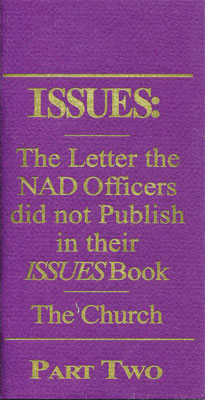
INTRODUCTION
The letter that composes the first part of this booklet was received
by us on January 19, 1993. It was sent to us by a supporter of Steps
to Life. In this letter we read, “in as much as this letter is to
be published . . . .“, indicating that this letter was written for
publication.
It appears from
this letter, that the NAD (North American Division) officers and
their committee, especially Robert Dale, requested letters against
“certain private organizations” to be used in their ISSUES book.
However, this letter is nowhere to be found in their ISSUES book.
We do not concur with the author of this letter on several points.
However, in the name of fair play, we believe this letter should
have been published in the NAD ISSUES book along- side the others.
We did not ask
permission of any person to publish this letter. The letter itself
states it was prepared for publication: “in as much as this letter
is to be published. . . .“ We have depersonalized it even further,
as you can tell by the blank _____ lines. This booklet contains
all of the letter that was sent to us. In the letter we received,
certain portions were missing, you will find these in [brackets].
“This is a partial
copy of a letter written by _____ of Andrews University, to Elder
Robert Dale of the N. A. D. . . . . I understand the letter was
sent in May 1992.” [written on the top of the letter we received]
The Letter the
NAD Officers did not Publish I do not agree with everything in Our
Firm Foundation. I receive a complimentary copy every month, but
I do not subscribe to the magazine and have never sent a donation.
Ron Spear has called me on the phone a couple of times over a period
of several years, but I have never called him. I would rather the
magazine didn’t exist. But I must add that I am, [ ] I among them,
appreciate quite a bit of what is published in the paper. Though
we deeply regret the critical spirit that appears at times and oppose
that one- time instruction on tithing, we nonetheless wish that
the best of Our Firm Foundation could appear in the Adventist Review.
We would like to see the magazine cease publication but feel that
for the time being it fills a useful place in feeding Christ's sheep.
1. Feed the
Sheep's Four Hungers.
The Review has
carried a variety of warnings, especially the Perth declaration,
aimed against
Our Firm Foundation
and other private publishing ventures. What I have not yet seen
but would like to see is an exploration into the reasons why these
private publishing ventures succeed.
Career malcontents
are going to publish critical materials no matter what any committee
comes up with, and neither spiritual appeals nor demagoguery will
make them stop. If the Committee is trying to reach career malcontents,
they might as well quote Nehemiah and refuse to waste their time.
I therefore
assume that the Committee is trying to reach, not the career malcontents,
but the loyal and reasonable church members who send donations to
support the independent publishers. So let us ask, Why do these
readers support these private publishers? I'd like to propose four
reasons, four legitimate hungers.
- A hunger
for what appears to be solid food.
Our Firm Foundation
is notable for its lengthy doctrinal articles and for its republished
appeals by Ellen G. White. Evidently, then, people are supporting
Our Firm Foundation because they want to read lengthy doctrinal
articles and they want to read earnest appeals written by Ellen
G. White.
- A hunger
for prophetic interpretation and application.
Several of
the independent papers consist largely of prophetic interpretation
and application. Evidently, then, people pay for these papers
because they want to read articles on prophetic interpretation
and application.
- A hunger
for the serious use of Ellen G. White.
The conservative
publications quote the Ellen G. White writings copiously and do
so as if they regarded the writings as authoritative.
- A hunger
for sincere repentance by church leadership.
It is easy to
dismiss the Pilgrims Press as merely salacious and erroneous. I
assure you that I don't subscribe to it and only rarely even see
a copy of it. But a very large number of Adventist church members
in the North American Division are aware that some of their leaders
are opinionated, selfish, and power hungry. Some of our church members
hunger for evidence of humility and the character of Christ in their
leaders.
Of course, a
lot of our NAD members don't have these four hungers, or don't have
all of them. Some of them scarcely read any of our papers, not even
their Union papers or the Review.
And some are
excited by Spectrum, with its criticism of Ellen G. White and the
sanctuary doctrine and its campaign for social activism and a billions-
of- years post- creation chronology.
But these less-
hungry people aren't sending their tithe to Our Firm Foundation,
so they aren't in the Committee's focus. Speaking about those who,
I presume, are in the Committee's focus, my first suggestion for
reclaiming the loyalty of people who read the independent publications
is that as promptly as possible the North American Division acknowledge
the four deep hungers I have listed as legitimate and meet them
with a. solid, sound doctrinal articles, b. solid, sound prophetic
interpretation and application, c. appropriate respect for the inspired
authority of Ellen G. White, and d. evidence of humility and the
character of Christ as needed among our leaders.
I have heard
(the information may be incorrect) that one of the reasons the Committee
is preparing a paper against the independent publications is that
“third world” ministers are basing sermons on articles in Our Firm
Foundation. Of course they are! Our Firm Foundation appears to meet
at least three of the four hungers. By contrast, the Adventist Review
usually offers little essays not over six typewritten pages in length,
pays only sporadic attention to the fulfillment of prophecy, virtually
never cites Ellen G. White for authoritative direction, and admits
the failings of denominational leadership only in extraordinary
areas of finance (e. g., Davenport and Harris Pine Mills). In response
to intense criticism, the Review has commendably begun the Anchor
Point series; but it occupies only a fraction of the available pages.
2. Avoid
Discrimination.
The Quiet Hour
accepts tithe. The Voice of Prophecy accepts tithe. The people at
Hope International know that the Quiet Hour accepts tithe and that
the Voice of Prophecy accepts tithe. Many other people either know
this or assume it. If the Committee clamps down on Hope International
and not on the Quiet Hour and the Voice of Prophecy, it will be
guilty of discrimination. Worse, it will likely be ineffective—
and will even run the risk of having Our Firm Foundation publish
the facts about QH and VOP and embarrass leadership.
[Added later:
I do not for a moment suggest that leadership ought to crack down
on either the QH or the VOP, even though acceptance of tithe by
both of them is contrary to voted NAD policy. They are both doing
a noble work and should be encouraged. When Elder Tucker in the
1950's accepted a call to Berrien Springs, the Northern California
Conference refused to let him take the Quiet Hour with him from
Oakland. Because the NCC had given the QH a small fraction of its
operating cost, it persuaded itself that it had full rights of ownership.
Tucker felt abused but stayed loyal. He waited till the QH in Oakland
failed before resuming it in Michigan, and when he resumed it, he
resolved he would never again accept even a penny from church leadership
but would, if possible, give money to the church. An this he and
his sons after him have done, with utmost loyalty and devotion.
To discipline the QH for occasionally accepting tithe— like Mrs.
White did— from people whose hungers are not being met by leadership,
would be a peculiarly abusive demonstration of “kingly power.”]
Now let me enlarge
the scope of discrimination. If our leadership is going to defrock
conservatives, it absolutely must be even handed and defrock supporters
of Spectrum. (Who the principals of Spectrum are can be identified
by a glance inside any front cover.)
Let us grant
that the General Conference has a right to define where tithe should
be paid. Very well, if leadership is going to defrock conservatives
for defying denominational policies on where tithe should be paid,
what is leadership going to do about the college staff which, scarcely
waiting for the ink to dry on the denominational vote restricting
extramural competition, ran an ad on the back of Insight saying
(as close as I can remember), “Meet You at Court Side.” Their ad
listed both the old and the newly added opportunities at their college
for extramural competition.
If leadership
is going to defrock conservatives for defying “denominational policy”
in regard to where tithe should be paid, what is leadership going
to do about the presidents of the Carolina Conference and the Southern
Union? Denominational policy requires Conference presidents and
Union presidents to respond “normally within three weeks” to appeals
from workers who request the Conciliation Process. A certain pastor
in the Carolina Conference has appealed at least five times for
the Conciliation Process over a period of nearly four years but
has been given a deaf ear, in disregard of denominational policy.
I have, literally, a drawer full of evidence that this pastor has
probably been treated insensitively and unfairly. I have appealed
to the leaders directly involved asking them to appoint an independent
third party to look into the situation and see if there might be
a basis for the pastor's complaints; but all that each of these
(otherwise good) brethren has done in response has been to consult
together and report to me (or not report at all) that everything
has been done just right. The pastor in question has been fired
and is in debt, with a wife who may be developing cancer that they
cannot afford to treat. Two individuals who are closer to the pastor
than I am, two people who for many years have been very loyal tithe-
paying Seventh- day Adventists, pastor. You can appreciate the fact,
Bob, that nothing the Committee publishes on tithe paying will persuade
these two people to follow “denominational policy” in regard to
where to send tithe as long as the brethren I have mentioned decline
to follow “denominational policy” on the Conciliation Process. I
think you can see their point.
On another theme,
who is speaking out officially in favor of the loyal, tithe paying
Seventh-day Adventists who for decades have supported our church
schools and our missionary magazines and the Voice of Prophecy,
etc., who now hate to attend their own churches because of the “evangelical
burlesque” (so- called Celebrationism) going on there in a misguided
attempt to retain the unconverted? Who is speaking out on their
behalf? If in a given conference no one is, can leadership there
in good conscience blame these loyal tithe paying Seventh- day Adventists
if, after paying their tithe to the conference for decades, they
now send some of it to someone who does have courage to speak out?
I don't agree with them in this use of some of their tithe. I only
say that if the Committee is serious about persuading such members
to return to paying all their tithe to the Conference, then the
Committee should persuade Conference leadership to speak up on their
behalf in respect to the worship- entertainment issue.
The Committee,
I say, must do all in its power to avoid discriminating against
easy conservative targets while neglecting to tackle the serious
problems that so deeply concern the easy conservative targets.
3. Evaluate
Actual Losses.
Inasmuch as
tithe is a major bone of contention, I’d like to ask the Committee
to find out just how much money the NAD is actually losing to the
independent publications. Is the amount worth the blood that may
be shed by a frontal assault?
To determine
the money being lost to the NAD, tallying up the income of the independent
publications isn't good enough. It is my current impression that
many of the Adventists who are sending donations to these publications
would not start sending their money to the Conferences if these
publications were today shut down. So long as their four hungers
persist unsatisfied, they will send their money elsewhere or bide
their time till the publications are replaced with other independent
publications.
What I'm trying
to say in this section is that the loss of offerings to these publications
is not due to the existence of the publications but to the doubtful
quality of the Review and the apparent lack of humility and repentance
among some of our leaders.
I would also
like to urge that the amount of money these publications are receiving
is relatively small, and that the proportion of tithe involved is
very small.
Suppose Hope
International, the largest publisher, does actually receive $1,250,000
a year as Ron Spear, when I asked him, told me that it does. Well,
the total church contributions made by NAD Adventists is over $600,000,000.
So Ron Spear gets only 1/ 500th (0.2%), a sizable amount to be sure,
but scarcely enough to credit him with holding up the general progress
of the cause.
But what about
the tithe he receives, the increment of his earnings most zealously
targeted by denominational leadership? Spear says (I am told) that
only about 10% of his $1,250,000 represents tithe. By nature he
seems to be an open man with figures, but let's suppose that the
tithe total is closer to 20%. Twenty percent of $1,250,000 is $250,000—
whereas NAD Adventists give $400,000,000 tithe each year. So let's
figure it out. The tithe that creeps into Hope International represents
at most 1/ 1600th (0.0625%) of total NAD Adventist tithe paying.
Against the
amount of money that might be regained by opposing the independent
publications, the Committee will want to weigh the value of souls
who may become discouraged by a denominational outburst. What will
it profit the church to gain several thousand dollars but lose hundreds
of souls?
4. Remove
the Offense.
You said in
your letter that the Committee dealing with Hope International wants
to be “balanced.” This is commendable; and I expect the objective
is sincere. You ask my comments in a desire to achieve this end.
Inasmuch as you asked, let me continue to oblige.
What about Spectrum
and its parent organization, The Association of Adventist Forums?
If you don't read Spectrum, I don't blame you. But you probably
made an exception and read about Elder Folkenberg and the anonymous
donors in the August 1991 issue. Is it all right for
Spectrum to
be sharply critical of leadership but not for Pilgrim's Press to
be critical? What about “Growing Up with the Beasts” and “Social
Reform as Sacrament of the Second Advent” in the May 1991 issue
of Spectrum? These articles reinterpret the beasts of Revelation
as social ills and the “remnant” as social activists. The Committee
should also savor the relish with which the magazine's March 1992
issue, on pp. 63- 64, reported that Seventh- day Adventist Kinship
International won its trademark case with the General Conference.
The Committee should then read the articles about Desmond Ford and
by Ford himself beginning on pp. 9 and 12 of the March issue.
Inasmuch as
this letter is to be published, I am deleting the names of certain
individuals whose behavior and theology are strikingly out of harmony
with normal Adventism. But I have privately called them to your
attention.
What about the
seven papers written by honor students at Walla Walla College in
the spring of 1991 that have received deserved notoriety. I understand
that Elder Folkenberg has reproved the WWC religion faculty, and
I'm mighty glad to hope that the report is true. But will there
be any real change at WWC?
What are our
people to expect of Adventist education as long as strong supporters
of Spectrum serve as college presidents? As long as the president
of Atlantic Union College is the man who publicly praised another
of our retired educators for coming out in favor of a billions-
of years post- creation chronology, can we reasonably expect our
conservatives to support our schools?
As earnestly
as I am capable of saying it, if the Committee is serious about
reclaiming the loyalty of those people who support our independent
conservative publications, I urge it first of all to set about removing
the most obvious offenses.
5. Review
Our History.
Our Firm Foundation,
like some of our other independent publications, (a) speaks of a
“new theology” that it says arose in the 1950's. It (b) emphasizes
that Jesus had the same human inheritance as we all have, rather
than having been created as clean as Adam. And it (c) talks about
perfecting our characters in preparation for the second coming.
These emphases
annoy a branch of our conservatives even more than they also annoy
our liberals. These annoyed conservatives almost angrily scold Our
Firm Foundation for emphasizing doctrines that are “not generally
agreed on” in our denomination.
But does their
distaste for Our Firm Foundation on these points prove that the
magazine is wrong on these points? [ ]theology for over twenty years,
requiring me to do constant research. I have [ ] with my antennae
out for the same length of time, and have served as a minister since
1946. 1 can say unequivocally that in the 1950's Adventist theology
as taught in our NAD centers did undergo a change, one that can
be attributed especially but not exclusively to two of the editors
of Questions on Doctrine and to at least two fascinating and influential
Seminary professors— a change which has been perpetuated and (we
must recognize) distorted by students who rose quickly to positions
of educational and administrative prominence. Yes, indeed, there
is a “new theology,” and Our Firm Foundation is historically correct
when it refers to it.
Perhaps, however,
we should say, more precisely, that certain views which had been
held for some time by a minority were, in the 1950's, reformulated,
given new emphasis, and taken up by a large group of those Adventists
who enjoyed the advantage of attending our schools. I believe in
our schools ______, but I observe that the theological cleavage
which exists today among conservative NAD Adventists is largely
between those who have studied the writings of non- SDA theologians
in our colleges on the one hand and, on the other hand, those who,
deprived of an SDA college education, have confined their study
mostly to the Bible and the writings of Ellen G. White. I am repeatedly
struck with the way new converts, fresh from the study of the Bible
and Ellen G. White, side with the older SDA theology, while so-
called “second” and “third- generation” Adventists tend to side
with the new theology.
Maybe I should
add at this point that I think that some language used by the QOD
editors in defense of their product set an ugly stage that leadership
still needs to sweep clean. Deeply embarrassed to have the Evangelicals
discover that many Adventists did not agree with QOD's new theology,
the QOD editors cruelly denounced the conservatives as a “lunatic
fringe.” I knew a lot of those lunatics and respected them highly.
They included the fine PUC teachers who set the tone of my ministry.
Well, leaders can say things like this, but it seems hardly reasonable
for them to expect people they call lunatics to enjoy paying them
their tithe.
The cry is often
raised by the new- theology conservatives that Our Firm Foundation
and similar publications are all wrong when they insist on the view
that Jesus was not given a pre- f all nature like Adam's. These
new- theology conservatives say that the publications are wrong
in that they insist on a view of Christ's nature that has never
been accepted as a Fundamental Belief by the church as a whole.
But if the denomination
has never taken an official stand on this subject, why is it wrong
for the old- theology conservatives to publish articles on the subject
but perfectly right for the new theology conservatives to do so?
New- theology conservatives such as the editors of Our Firm Foundation
are frequently criticized for bringing up the issue. But let's face
it; they didn’t start the argument! The argument was started publicly
by the 1949 edition of Bible Readings and the 1957 publication of
Questions on Doctrine, and by certain Seminary professors and others
in the years that followed. And the pot has been kept boiling by
the professors and others in the years that followed. And the pot
has been kept boiling by the new- theology liberals and conservatives,
who now control several of our magazines and colleges. One recalls
the old quip:
“You started
the fight when you hit me back.” The fact that new- theology people
control the chief NAD publications and colleges represents choices
made by entities of the NAD. Choices involve consequences. If NAD
entities have chosen such editors and presidents, NAD must expect
a reaction. It is in my opinion irresponsible and unsportsmanlike
for NAD to choose partisans of new- theology views which have not
been officially accepted by the General Conference and then cry
foul when loyal church members publish evidence in favor of the
old- theology views which they committed themselves to when they
became Seventh- day Adventists.
6. Assess
the implications of Voluntaryism.
I have just
spoken about the convictions of people who adopted certain understandings
when they became Seventh- day Adventists. If church leadership thinks
the time has come to teach different views from the views being
taught when these people became Seventh- day Adventists, that is
one thing. But to treat people as rebellious, heretical, disloyal,
and legalist because they choose to continue to believe what they
sincerely committed themselves to years ago, seems gross and boorish.
Commitment is
precious, and church membership is sacred. Church membership is
also entirely voluntary. Payment of tithe and offerings in the Seventh-
day Adventist movement is totally unenforceable. Loyalty is unenforceable.
Ours is a voluntary movement.
Members will
pay or will not pay tithe as they please. They will be loyal or
disloyal as they please, and no one can force them to be any different.
How important,
then, that our leaders seek consensus rather than political victories.
Our previous General Conference presidency was marked by increasingly
sharp politicization at the expense of consensus. You and the Committee
are painfully aware of this.
If leadership
wants to settle for, say, a vote of 60%, let it do so. No one can
stop it. But let leadership recognize that when it settles for 60%
it runs the real risk of alienating many of the other 40%. Alienation
and loyalty are opposite principles.
The trouble
with administrating a voluntary organization on the basis of major-
fraction votes is that the volunteers who are unconvinced may simply
stop being volunteers. How much better, how very much better, for
the church to move slowly enough and persuasively enough to secure
consensus!
One of the seething
causes of the current wave of unofficial publications is frustration
with disenfranchisement. Church leadership, apparently intent on
retaining our educated liberals, has found ways politically and
editorially to give several of the denomination's colleges, periodicals,
and key administrative positions to educated liberals. Time after
time our conservatives, the ones who still read the Spirit of Prophecy,
have been frustrated. Their articles have been rejected by denominational
editors. And even when they have written “letters to the editor,”
too often their letters haven't been published unless a contrary
letter was available for publication next to theirs, to make their
letters look foolish. All of this maneuvering has left many of our
thinking conservatives frustrated. But they love our church more
than they love their money. They are alarmed at the way things are
going because they care enough to be alarmed; and so, well, they
speak up through their own publications, and they put their money
where their mouths and hearts are. They are, after all, volunteers,
generous, giving volunteers who support the kind of Adventism they
believe in.
7. Conclusion.
It is my conviction,
as I said in beginning, that Our Firm Foundation ought to close
down. We ought not to need it. We ought to have an Adventist Review
that feeds our people's legitimate hungers without the accusing
spirit and without the false tithe advice sometimes found in Our
Firm Foundation. The Review— and our colleges, pastors, and teachers—
should feed our people's hunger for solid, sound doctrinal instruction,
for solid, sound material dealing with the fulfillment of prophecy,
and for solid respect for the inspired authority of Ellen G. White.
And our administrators should use the columns of the Review to make
earnest confession, acknowledging specific wrongs and offering specific
restitution.
The Committee
(it seems to me) should persuade leadership to act without discrimination,
removing offenses, and counting the possible gain in money against
the possible loss in souls.
In brief, in
dealing with the supporters of Our Firm Foundation, the Seventh-
day Adventist movement needs to display strong, clear- headed, moral
leadership. God give us moral leadership, armed by faith, winged
by prayer, and informed by the Spirit of Prophecy, its soul cleansed
and its influence enhanced where necessary through public confession
and repentance.
There is a danger
that God's commandment- keeping people will be found, as were the
Jews, weighed in the balance of the heavenly sanctuary, and found
wanting. YI
10/14/97
ISSUES: Part Two SECTION TWO TABLE OF CONTENTS
Spiritual Nature of the Church
The promises
Israel (Abraham's seed)
The apostasy in Christendom
When reformation of the church was impossible
Can you tell the difference between the true
church and the professed- only church?
Two true churches? (the invisible church)
The professed church and the true church
Who are God's denominated people?
Questions and answers
Appendix #1
Appendix #2
Appendix #3
Appendix #4
To be a Christian
is not merely to take the name of Christ, but to have the mind of
Christ, to submit to the will of God in all things. Many who profess
to be Christians have yet to learn this great lesson. Many know
little of what it is to deny self for Christ's sake. They do not
study how they can best glorify God and advance His cause. But it
is self, self, how can it be gratified? Such religion is worthless.
In the day of God those who possess it will be weighed in the balance
and found wanting. TMK 174
ISSUES: Part
Two SECTION TWO “The Church” Dr. John J. Grosboll
The church is
one of the things of God, the most precious thing on earth in His
sight. It has been established and purchased at an infinite cost
to heaven. What is it about the church that makes it so precious?
Although no human can give a complete answer to this question, a
very imperfect and partial answer could be as follows. When the
great controversy was inaugurated in heaven, God and His government
were challenged with the following justification: (1) First of all,
Lucifer claimed that God's law was unnecessary for angels, and second,
he claimed that created beings could not perfectly keep the law.
Lucifer wanted a change in God's law that would allow him to be
part of the Godhead or like God (this would require a change in
the first commandment and a change in the spiritual meaning of the
rest of the commandments). (2) Lucifer claimed that Christ had privileges
that he should have also. God did not at all consent to this demand.
(3) Lucifer claimed that he wanted to obtain more freedom and liberty
and that the principles of God's government did not work perfectly
and could be improved upon. Although Lucifer attempted to gain God's
condemnation by the entire universe of creatures created by God's
own hand, the nature of the charges made it impossible for God to
vindicate His character or government as God because the charges
which were accepted by about one third of the angels were not only
against God, His government and His law, but they claimed that created
beings could not keep His law and that His law resulted in a condition
of life for created beings that was inferior to that life which
could be enjoyed if the law were changed.
After Lucifer
was expelled from heaven, he determined to be revenged upon God
by causing the fall of our first parents, Adam and Eve, which he
succeeded in doing. When Adam and Eve fell, they lost their former
righteousness and purity of character. They were transgressors of
the first commandment and spiritually they had broken every commandment
in God's law (Romans 7: 14). Satan claimed that either Adam and
Eve would have to die with all the other transgressors of God's
law (including himself) or God would have to allow him and all the
other fallen angels back into heaven if Adam and Eve were forgiven.
God said to the devil, “I will put enmity between you and the woman
and between your seed and her seed. He will bruise your head and
you will bruise his heel” Genesis 3: 15.
SPIRITUAL
NATURE OF THE CHURCH
Here in Genesis
3: 15, immediately after the fall, God announces the establishment
of His church as His people. All people in the world can claim Eve
as their mother according to the flesh, but God was here speaking
only of those who would be, not just the fleshly descendants of
Eve, but her spiritual descendants— those who would demonstrate
by the character that they would develop that God was their Father
and the devil their adversary.
Immediately
after the fall of man, the spiritual nature of the church is revealed.
There would be descendants of Eve that would be the seed of the
devil— his spiritual children— and there would be enmity between
these descendants of Eve according to the flesh and the descendants
of Eve who were not only her fleshly but her spiritual children.
Immediately after the fall, God makes it plain that ONLY the spiritual
descendants of Eve are His people, His church. Those who are only
her descendants according to the flesh, or who make a profession
of being His children but develop characters like Satan, are the
seed of the serpent and are not God's children or part of His church
at all. “There must be open and avowed enmity between the church
and the serpent, between her seed and his seed” ST 8/ 26/ 89.
THE PROMISES
From this time
on, often the church was again likened to a woman or sometimes the
seed of the woman. This promise in Genesis 3: 15 was passed down
for twenty generations. In the twentieth generation, the promise
was renewed and more explicitly stated to Abraham in Genesis 12,
15, and 17. God's covenant renewed with Abraham included the following
provisions: (1) The sign or token that one had entered into this
covenant was the rite of circumcision (Genesis 17: 10- 14). (2)
For everyone who entered into this covenant, God promises to be
their God (Genesis 17: 7, 8). (3) God promised that everyone who
was part of this covenant would “inherit the land in which you are
a stranger” (Genesis 17: 8). Some have thought that this refers
only to the land of Palestine, but Abraham understood it to refer
not only to Palestine but to an eternal inheritance in the earth
made new at the end of time (Hebrews 11: 8- 10). The righteous are
strangers in this earth (Hebrews 11: 13- 16; 1 Peter 1: 1), but
they will inherit the earth (Psalm 37). (4) To be part of the covenant
you must be part of Abraham's seed because the covenant was made
only to Abraham and his seed (Genesis 17: 7). (5) The covenant was
not made with the fleshly descendants of Abraham but only with those
who were his spiritual seed. We know for sure that this was a condition
of the covenant from the beginning because Ishmael was of the seed
of Abraham according to the flesh and was circumcised— he received
the token or symbol of being part of the covenant (Genesis 17: 25),
yet Ishmael was never part of the covenant! (see Romans 9) This
is absolute proof that to be part of the covenant or testament you
must be the spiritual seed of Abraham, not just the literal seed.
In fact, you could be part of the spiritual seed of Abraham and
thereby be part of the covenant even if you were not of the seed
of Abraham according to the flesh. The experience of Rahab the harlot
in Jericho and of Ruth the Moabitess who became one of the progenitors
of Christ demonstrates this fact— neither were of the physical seed
of Abraham, but they both became part of his spiritual seed, so
much so, that Ruth was chosen to be an ancestor of the Christ who
was to come from the seed of Abraham.
ISRAEL (ABRAHAM'S
SEED)
This covenant
or testament of promise was renewed with Isaac and Jacob. After
the night of Jacob's trouble, God changed Jacob's name to Israel,
which means “a prince with God,” and this became the official name
of God's people in this world forever. (This is not the only official
name of God's people today, however.) From this time on, one of
the most common names for God's church is “Israel.” In describing
the victory of the saints at the end of the time of trouble, Ellen
White calls them the Israel of God (EW 285).
However, many
in ancient times and today are confused because they think that
whenever the Bible talks about Israel it is talking about God's
true church. This assumption is often not true.
The human mind
was originally created to operate in harmony and within the parameters
of the Ten Commandments. Almost all learning from babyhood is based
on the assumption that what is heard or what is seen is the truth.
Without an observance of the ninth commandment, no order or learning
can take place. But sin deceived (Romans 7: 11) and people who were
the descendants of Abraham according to the flesh did not develop
a character of faith and love like Abraham. They were his descendants
according to the flesh, but they were not his spiritual descendants;
they were not God's children. Therefore an element of confusion
was initiated which has continued to the present day: people who
professed to be the children of Abraham, Israelites, God's people,
part of His church, were not the spiritual children of Abraham at
all; spiritually they were not Israelites but they were called Israel;
they professed to be part of Israel; they professed the same religion
and were called Israelites (and they were Israelites according to
the flesh). They were Israel by profession but not in reality. This
is one of the awful results of sin— you cannot determine reality
by a person's profession or word.
Even a casual
reading of the Old Testament reveals that many who were Israelites
according to the flesh were not God's people (some of them were
called by the Old Testament writers the sons of Belial, that is,
the devil); whereas those who are really part of His church are
His people. Notice how explicitly the Bible writer states it: “They
are not all Israel who are of Israel” Romans 9: 6. Those who are
of Israel are those who profess to be God's people, those who profess
to be the Israel of God; but not all of these are really Israel;
not all of them are really God's people; not all of them are really
part of the church. Today as then there are many who are “of Israel.”
They have received the rite of baptism; they have professed to be
God's people; they are accounted by men to be God's people, His
church; they are numbered with God's people and joined to them,
but they are not really part of the church at all— they are only
“pretended believers,” they are “false brethren” (COL). A false
brother is not a true brother, but all those who are really part
of the church are true brethren.
Until this basic
fact is understood, much confusion will exist in the mind of a student
of the Bible or the Spirit of Prophecy. In the Bible “different
meanings are expressed by the same word; there is not one word for
each distinct idea” 1SM 20. If the word Israel or the word church
is always interpreted to mean the same thing, then explicit contradictions
are found in the inspired writings; but a real contradiction is
impossible because ‘‘ all truth. . . . is consistent with itself
in all its manifestations PP 114. No lie is of the truth (1 John
2: 21).
It is a common
practice when an apparent contradiction occurs in inspired writings
for students to make philosophical models to explain these contradictions.
Because those who are part of the true church by profession and
those who are part of the true church in character (reality) as
well as profession have not been the same group for thousands of
years and the prophets are using the imperfect language of men (1SM
20) in prophetic writings, both groups are often called simply “the
church.”
In the Bible
the word law is another example of the imperfectness of human speech.
Sometimes the Bible writer uses the word law when talking about
the Ten Commandments. At other times the same word without qualifiers
is used to describe the ceremonial law or the same word is used
to describe the first five books of Moses which were called the
law in the Hebrew Bible. And still other times the word law is used
to describe the effect of sin on a person or persons. In each case,
the context of the verse must be examined to determine what law
is being talked about.
This multiple
use of the word law has been a prolific field for misunderstanding
in which Seventh- day Adventists have had to learn how to explain
the different ways that the word is used and that the moral law
of Ten Commandments has never been and never can be changed. If
a person is candidly looking for evidence, the different ways that
the word law is used can be demonstrated from the text itself so
that there is no real contradiction, even though from the first
casual reading there had seemed to be. The same is true for the
word church.
Until it is
understood that “they are not all Israel who are of Israel,” the
Old Testament prophets cannot be properly understood because when
they use the word Israel, sometimes they are talking about the real
or true Israel of God, His true church, and sometimes they are talking
about Israel according to the flesh, those who profess to be Israel
but are not all Israel. A knowledge of this fact explains many apparent
contradictions in the Old Testament. For example, compare the following
apparently direct contradictions: “I have forsaken My house, I have
left My heritage”; Jeremiah 12: 7 (see also Deuteronomy 31: 17;
Isaiah 2: 6; Jeremiah 7: 29; 2 Chronicles 15: 2; 24: 20) and “For
Israel is not forsaken nor Judah by his God, the Lord of hosts,
though their land was filled with sin against the Holy One of Israel
” Jeremiah 51: 5 (see also Deuteronomy 31: 6, 8). How do you explain
this apparently direct contradiction? An examination of all similar
passages reveals the answer. The professed Israel, or Israel according
to the flesh, the professed church of that day was forsaken and
left by God (Ezekiel describes it graphically in the first chapters
of his book.) because they had forsaken Him; but the true Israel
of God never has been and never will be forsaken (Hebrews 13: 6).
Those who will never be forsaken are the spiritual seed 01 Abraham—
those who seek God and put their trust in Him (Psalm 9: 10), those
who are righteous, the saints (Psalm 37: 25,28). Because God's professed
people forsook Him, He forsook them; but even though the land (that
actually belonged only to His true people) was filled with the sin
of His professed people, His true people were not forsaken and never
will be.
But in Bible
times as today people often base their life on what they can see
and not on the spiritual reality of a godly character. Most of the
tribes of the children of Israel were “lost” as a result of the
Assyrian captivity and have not since that time had a distinct visible
identity. Of the Israelites who remained, the majority were of the
tribe of Judah and the name for God's true people became the Jews
instead of Israel (which they still were).
Most of the
Jews eventually put their trust in the outward church organization
instead of developing a godly character. They became so confused
their thinking that they thought the outward manifestations or symbols
of true religion were the essence itself. They could not tell the
difference between the professed church and the true church. They
could not distinguish the form from the substance. They could not
tell the difference between profession and spiritual reality. This
is always the result of spiritual blindness. (Jesus said that the
Jews were spiritually blind— John 9 and Matthew 15.) This is one
of the main reason for the confusion today about who and what the
church is— Laodicea is spiritually blind.
One of the results
of this misperception is that religious faith and trust is placed
in church organizations, creeds and outward forms of religion. When
trust is placed in the creature instead of the Creator, instead
of fearing God (Revelation 14: 6) men fear other men. This fear
of men is amply documented in the gospels which speak often about
the fear of the Jews (see John 7; 9; 12).
Also, whenever
spiritual blindness has occurred, the emphasis in religion is always
upon the physical— circumcision of the flesh, baptism with water,
the attainment of various human goals and objectives; but it does
no good to keep the symbols if the spiritual reality that is symbolized
is lost. Circumcision represented the cutting away of sin from the
life (Deuteronomy 30: 6); baptism represents the washing away of
sin from the life and the baptism of the Holy Spirit. It does no
good to observe the symbol if the spiritual reality is not experienced.
When Jesus was
here, the Jews believed they were the true church because they were
the seed of Abraham. They forgot that the promises were given only
to the spiritual seed. They forgot that without a spiritual similarity
to Abraham, a genealogy showing your fleshly connection to him was
useless. When John the Baptist said, “And do not think to say to
yourselves, ‘We have Abraham as our father, ' ' For I say to you
that God is able to raise up children to Abraham from these stones”
Matthew 3: 9, he was assaulting their most treasured religious beliefs.
They believed that, because they were Abraham's descendants, they
were members of the true church, the true people of God. John the
Baptist told them not to think that a fleshly connection to Abraham
guaranteed this. “John declared to the Jews that their standing
before God was to be decided by their character and life. Profession
was worthless. If their life and character were not in harmony with
God's law, they were not His people” DA 107. (All emphasis supplied)
It was true that to become Abraham's seed was to have everlasting
life, but the Jews thought it was the literal seed that counted
and John the Baptist said that this counted for nothing— profession
counted for nothing. It was character that counted and God could
raise up from the stones (Gentiles— people spiritually dead) people
who would have the character of Abraham and therefore be in the
most literal sense Abraham's spiritual children. John the Baptist
said that it was character likeness or spiritual relationship to
Abraham that counted, not an outward relationship of profession
(or of the flesh).
Jesus stated
this truth in even stronger language “‘ I know that you are Abraham's
descendants, but you seek to kill Me, because My word has no place
in you. I speak what I have seen with My Father and you do what
you have seen with your father. They answered and said to Him, ‘Abraham
is our father. ' Jesus said to them, ‘If you were Abraham' children,
you would do the works of Abraham. Bu now you seek to kill Me, a
Man who has told you the truth which I heard from God. Abraham did
no do this. You do the deeds of your father. ' Then the said to
Him, ‘We were not born of fornication; w have one Father— God. '
Jesus said to them, ‘I God were your Father, you would love Me,
for proceeded forth and came from God; nor have come of Myself,
but He sent Me. Why do you not understand My speech? Because you
are not able to listen to My word. You are of your father the devil,
and the desires of your father you want to do. He was a murderer
from the beginning, and does not stand in the truth, because there
is no truth in him. When he speaks a lie, he speaks from his own
resources, for he is a liar and the father of it” ' John 8: 37-
44.
Jesus acknowledged
that they were the descendants of Abraham according to the flesh,
but He denied that they were the children of promise. He denied
that they were Abraham's spiritual seed; He denied that they were
part of the church, rather Jesus said plainly that they were of
the synagogue of Satan. Jesus here made it plain that it was spiritual
or character likeness that counted.
“The Pharisees
had declared themselves the children of Abraham. Jesus told them
that this claim could be established only by doing the works of
Abraham. The true children of Abraham would live, as he did, a life
of obedience to God. They would not try to kill One who was speaking
the truth that was given Him from God. In plotting against Christ,
the rabbis were not doing the works of Abraham. A mere lineal descent
from Abraham was of no value.
Without a spiritual
connection with Him, which would be manifested in possessing the
same spirit, and doing the same works, they were not His children”
DA 466, 467.
The Jews believed
that the professed church professed Israel (Israel according to
the flesh), was the true church; but Jesus said that they were not
truly the children of Abraham but rather the children of the devil—
they were not the true church at all, but of the synagogue of Satan,
the devil's children. They were the professed church of God. the
professed people of God, the professed true church, but not the
true church at all in reality. In a time of apostasy, the professed
church and the true church is not the same at all.
This same battle
over the definition of the true church— that the professed or outward
church is not the same as the true church— had to be fought by the
apostles and is discussed in detail in the New Testament, not only
in the gospels but in the epistles and other New Testament books.
The theology
of the Jews taught that the professed church was the true church.
The theology of the apostles taught that the true church could only
be defined by spiritual relationship and not on profession alone.
The Jews thought
that the fleshly seed of Abraham or the professed church was the
true church, but the apostles taught that only the spiritual seed
was truly the church (Romans 4: 13- 17; 9: 8; Galatians 3: 7).
The Jews thought
that the visible, outward relationship was what counted, but the
apostles taught that it was the inward, vital relationship that
counted (Romans 2: 28, 29).
The Jews professed
to be the true church of God. If you could not tell the difference
between the professed church and the true church, you would not
have become a member of the apostolic church at Pentecost.
THE APOSTASY
IN CHRISTENDOM
However, in
Christendom something very similar happened to what had formerly
happened in Judaism. Part of the great apostasy in Christianity,
was the teaching which has affected Christendom to the present day
that “Christianity consists in the mere profession of the name pertaining
not to the essential character, nor implying any material change
in the general conduct” Great Empires of Bible Prophecy, A. T. Jones,
471.
A person calling
himself a Christian, professing to be a Christian but not living
a Christlike life, is a fraud; he is a Christian in name but not
in character. He is not really a true Christian but a professed
Christian only. Likewise a church professing to be Christian but
breaking God's law, teaching others to break God's law or saying
that it cannot be kept, is a Christian church in name only, not
in reality. It is not a true Christian church at all. As apostasy
comes into a church, the whole church is of professed Christians;
but within the professed church is a usually much smaller number
of true Christians whose character is in harmony with their profession.
A true Christian may not have character perfection yet and may be
making many mistakes, but he will be loyal to the commandments of
God and the testimony of Jesus or spirit of prophecy and will not
seek any excuse to explain away disobedience.
Professing Christians
became confused again between the profession and the reality. A
philosophy was developed which has enslaved billions of human beings
right up to the present day. Seventh- day Adventists are not exempt
from this slavery. Again the confusion had to do with the identification
of the true church just as in the days of John the Baptist, Jesus
and the apostles. The philosophy which has enslaved so many could
be summarized like this:
Christians were
taught and believed that you could only have eternal life if you
belonged to the “visible church.” They believed that this was the
professed Christian organization who claimed to have received apostolic
authority directly from a line of uninterrupted bishops all the
way back to Peter and that these bishops had the keys to the kingdom
of heaven and could send a person to heaven or hell. People believed
that if these bishops or their appointed subordinates cut one off
from their church organization (excommunication and mass excommunications
called interdicts), that one would lose eternal life and go to everlasting
burnings.
WHEN REFORMATION
OF THE CHURCH WAS IMPOSSIBLE
As in the time
of Christ, people were confused between profession and real spiritual
relationship. Eternal life is only for those who are a part of the
body of Christ, but who is part of the body of Christ? It is spiritual
relationship and not merely visible profession that makes one a
part of the church or the body of Christ (see Ephesians 5: 25- 32).
There has only
been one church since the beginning of time. The apostolic church
was not a new church, and the Seventh- day Adventist Church is not
a new church founded in the nineteenth century. The Adventist Church
is but the remnant of the church that has existed since the beginning
of time (see Revelation 12 and the first chapter of Acts of the
Apostles).
The keys to
the kingdom of heaven— the power to bind and loose— is given to
all Christians (see 1 Corinthians 5 and Matthew 18: 15- 20), but
a person is not a Christian unless he is Christlike in character
(see 1 John 3). In other words, it is impossible for any person
or group of persons who do not have a Christlike character to actually
cast a person out of the true church. In the Dark Ages there never
could be revival or reformation until the fear of man was broken.
Many Roman Catholics abhorred the apostasy which had engulfed the
Christian world and they wrote and preached about the need of revival
and reformation, but reformation was impossible. Every time revival
and reformation started, the church threatened excommunication.
Revival and
reformation could never come until the fear of man was overcome.
In Jesus' time you had to overcome your fear of man to follow Jesus.
In the Dark Ages and in the time of the Reformers you had to overcome
your “fear of man” to follow truth (see John 14: 6). It was impossible
for the Reformation to succeed as long as people thought they would
lose eternal life if the church excommunicated them. Until men understood
who and what the church was according to the New Testament, there
could be no reformation. People could see that the men who were
operating the church were wicked, but they said the church is holy!
Those who were following the doctrines and teachings of the church
were evil, but they said the church was righteous!
Again, as in
the days of Christ, men had mistaken profession for character, the
symbols for the substance, the forms and rituals for the reality.
Again mankind had to learn that if the character does not conform
to the profession, all the professions in the world are worse than
meaningless because, if our character does not conform to our profession,
we are living a lie. The devil's most successful agents are men
and women who profess to be Christians but are unlike Christ in
character.
Who has apostolic
authority? The doctrine of apostolic succession teaches that Christ
gave to the apostle Peter apostolic authority and this apostolic
authority was passed down in succession to each later bishop of
Rome (the pope). Ellen White comments on this “question that has
long agitated the Christian world,— the question of apostolic succession.
Descent from Abraham was proved, not by name and lineage, but by
likeness of character. So the apostolic succession rests not upon
the transmission of ecclesiastical authority, but upon spiritual
relationship.
A life actuated
by the apostles' spirit, the belief and teaching of the truth they
taught, this is the true evidence of apostolic succession. This
is what constitutes men the successors of the first teachers of
the gospel” DA 467.
This is especially
applicable in the present day when such an ado is being made about
who has authority to baptize, preach, write, or ordain or to call
himself a Seventh- day Adventist, a Seventh- day Adventist minister
or a Seventh- day Adventist Church. A real or true Seventh-day Adventist
minister (an historic Seventh- day Adventist) will teach and preach
the Seventh-day Adventist message that God raised up the second advent
movement to proclaim to the world— Revelation 14: 6- 12. A person
who claims to be a Seventh- day Adventist minister who is not preaching
this message is not really a Seventh- day Adventist minister, no
matter what credentials he has; and a person who is preaching the
historic Adventist message is a Seventh-day Adventist minister, whether
he has received credentials or not. The way some reason today would
have kept them from hearing John the Baptist and Jesus and, for
sure, the apostle Paul.
I wonder, have
we learned and retained the lesson the apostles had to learn about
the identity of the true church? Have we learned and retained the
lesson the Reformers had to learn about who the church is? Is there
any chance that in these last days the devil has forgotten errors
which he has used so successfully in the time of Christ and since
that time to cause the loss of countless millions of human beings?
CAN YOU TELL
THE DIFFERENCE BETWEEN THE TRUE CHURCH AND THE PROFESSED- ONLY CHURCH?
In the days
of Jesus and the apostles, unless you could tell the difference
between the real true church and the professed true church you would
never have been a Christian. The Jewish church professed to be the
true church of God all the days of the apostle Paul (see Sketches
from the Life of Paul, 226). In a time of apostasy, unless you can
tell the difference, you will not be able to make proper decisions
about what church to be a part of.
The Jews believed
that the true church was professed Israel, but the apostles taught
that the true church was spiritual Israel only (see Romans 9: 6-
8).
You become a
member of God's professed people when you are baptized with water,
but you only become a member of God's true people when you are baptized
with the Holy Spirit—” By one Spirit we are all baptized into one
body” 1 Corinthians 12: 13. Baptism with water is a symbol of baptism
with the Holy Spirit and after the ratification of the New Covenant,
if a person does not receive the Holy Spirit at his baptism (Acts
2: 38), his baptism is only a form.
You are in reality
part of the church only when you partake of the life of Christ;
and the person who partakes of the devil's program of living— any
kind of living in known sin— is not a member of the body of Christ
(the church) no matter what his profession is (1 Corinthians 10:
15- 21).
Being part of
the true church involves a vital union with Christ, but a person
can be a part of the professed church with only a superficial or
professed union with Christ (Ephesians 5: 32; John 12: 40- 42).
To really be
a member of the true remnant church, you must keep the commandments
and have the spirit of prophecy (Revelation 12: 17 and 19: 10);
but you may profess to be a member, and outwardly be a member in
a time of apostasy, and not live according to the spirit of prophecy
or keep God's commandments.
There could
be no sixteenth century reformation until men understood who the
true church really was because as long as they thought that they
would burn in hell- fire if the church excommunicated them, fear
of men would prevent any lasting reformation.
Disfellowshipping
is occurring again today and a lasting revival and reformation cannot
occur until men and women have no fear of what men can do. Whole
churches are being disbanded. We must face reality. Whole conferences
and even divisions could be lost. Even the General Conference could
be lost in the battle before the final victory of God's saints.
Actually, all of these entities will be lost and destroyed if there
is not true repentance, confession of wrong and restitution, and
a determination to stand on the solid platform where the church
militant stands (UL 152). If you are not prepared for such an eventuality,
you simply are not prepared for what is very rapidly developing
among God's professed people today (see None Dare Call It Apostasy).
Many who are professed “Christians” are actually part of the synagogue
of Satan— Revelation 2: 9— they are not really part of the body
of Christ, or the church, at all. This can be true of people in
all churches, including the Seventh- day Adventist Church.
“The trials
of the Children of Israel, and their attitude just before the first
coming of Christ, have been presented before me again and again
to illustrate the position of the people of God in their experience
before the second coming of Christ” 1SM 406.
TWO TRUE
CHURCHES? (THE INVISIBLE CHURCH)
In attempting
to create a philosophical model which will explain the apparent
contradictions in inspired writings, many inventions have been developed.
One of the oldest of these is the theory of two true churches. The
Bible teaches that there is only one true church (Ephesians 4: 4).
This is true for both time and space. Ellen White concurs with this
Biblical teaching as you would expect (see the first chapter of
Acts of the Apostles) . There has only been one true church since
the beginning of time and there is only one true church in all the
universe. Ellen White says that the church in heaven and the church
on earth are one (ST 6/ 6/ 95; 6T 366) and also that from the beginning
of time faithful souls have constituted the church (AA 11; OHC 172).
There have not
been two or three or six churches since the beginning. The church
in Old Testament times, in the days of the apostles, and today are
not separate churches even though they might be called by different
names to designate the time or place being spoken of. They are each
a part of the one church that has been since the beginning. This
one church has always gone through and it will always go through.
The true church went through in Jesus' day, but very few of the
professed church went through with it. The same was true in the
time of the midnight cry and the same will be true at the end.
In the Dark
Ages the theory of two true churches was developed. The theory went
like this, “There is an invisible church and Christ is the head
of that and there is a visible church and the pope is the head of
that.” Concerning this theory John Wycliffe said that if the church
had two heads, it was a monster. All the Protestant Reformers said
that the church had only one head and that head was Christ (Ephesians
1: 22, 23).
The concept
that there are two true churches, a visible church and an invisible
church, is heresy and is not acknowledged by any inspired writer.
This false teaching forms the foundation of an entire theological
structure which may seem very logical but is not based on inspired
writings. This theory was part of the confusion of the Dark Ages
and, unfortunately, many have imbibed this ancient heresy and brought
it into their experience today. This theory and all the theology
built on it will end in disaster. It results in a totally distorted
concept of who the church is. Anytime anyone starts talking about
the “invisible church,” a red flag should wave in your mind and
the bells should start ringing in your head that you are being taught
heresy. Not once does Ellen White ever talk about an invisible church.
It is true that
part of the true church is presently invisible to us, but it is
not a separate entity or church. Ellen White says that the church
on earth and the church in heaven are one and we cannot presently
see the church in heaven while the church on earth is visible to
us, but inspired writers never speak of a separate entity or church
called the invisible church. Such an entity does not exist. Like
the Virgin Mary, an entire theology has been built up over an assumption
which is none- existent. When the foundation of a theology is based
on a false assumption, no matter how logical the system is, it is
entirely false.
Many Protestant
theology students have been surprised to find out how logical Roman
Catholic theology is. But even though it is logical, it is still
false because it is built on a false foundation— the assumption
that the Roman bishop is by divine right the head over all the churches
in the world and that the decrees of the church supersede the Bible.
In the same way, all the theology built on the theory of two true
churches, a visible and an invisible church, will someday be seen
to have caused the loss of a multitude of souls because it is built
on a false foundation. One of the most common ways that this man-
made theory is used to cause the loss of souls is to define the
visible church as a certain church organization and then take inspired
statements concerning the true church and use them to influence
people to be faithful to that church organization no matter how
deep in apostasy or sin it becomes. This sly tactic caused the loss
of millions of souls during the Dark Ages and the devil has not
forgotten it.
The net effect
of creating two true churches and designating them the visible and
the invisible church is to enable a person to ignore some of the
plainest statements in inspired writings about who and what the
church is. One of the most common ways that this man- made theory
is used to cause the loss of souls is to pre- define the inspired
statements about the true church to refer to a non- entity, the
invisible church, and then simply sweep aside all the inspired statements
that explicitly define who and what the church is. The most clear,
simple, convincing and explicit definition statements in inspired
writings are simply made of none- effect by this theory. But the
statements still say the same thing and they will still have to
be faced in the judgment if at no other time. It is not honest to
take the clear statements of inspiration and simply sweep them aside
and arbitrarily relegate them to something that really does not
exist— the invisible church. Once this heresy has really taken hold
of a person's mind you cannot touch them with any evidence from
inspired writings— as soon as you read a definition statement about
the church, they immediately decide in their mind that the statement
is talking about the invisible church (which term Ellen White never
uses) and then refer to a quotation in which the word church is
used in a different way to prove their position. It is very similar
to talking to a Church of Christ member about the Sabbath and the
law. The clearest statements in Scripture are swept aside with the
theological system they have developed and then texts talking about
the ceremonial law are used to prove that you are in error.
For example,
in at least five places in the Ellen White writings you will find
a statement similar to the following: “All down through the history
of the world, faithful souls have constituted the church on earth”
OHC 172 (see also AA 11; RH 12/ 4/ 1900). This is not just a sentence
in which the word church appears, as are many of the statements
used by those teaching the heresy of the invisible church. This
is a definition statement of who and what the church is. But those
who believe in the false doctrine of two true churches, a visible
and an invisible church, sweep away this plain inspired definition
of who and what the church is and make it of none effect by saying
that it refers to the nonentity that they have concocted in their
imagination— the invisible church. They make the plain inspired
Word of God of none effect by their tradition— their man- made doctrine
of the invisible church.
Notice that
this statement is not talking about the church triumphant. It is
talking about the church down through the history of the world or,
as is stated in Acts of the Apostles on page 11, the church that
has existed from the beginning. I
Incidentally,
what does the word constitute mean? Synonyms would be the words
compose , comprise, form, and make up. If you insert any of these
simple words into the definition statement of Ellen White as to
who and what the church is, you will see how plain inspiration is
in defining who and what the church is. In the Appendix of this
booklet there are listed numerous inspired definitions of the church;
but if this was the only definition you had, you would have enough
to know the truth for sure— you would never need to be mixed up
because truth is always consistent with itself in all its manifestations
(PP 113) and you can be sure that Ellen White, being an inspired
prophet of the Lord, will never say anything in any other context
that will contradict her plain definition statements about who and
what the church is. If you are really a sincere seeker for truth,
you will interpret all difficult texts that you may not understand
in the Bible and Spirit of Prophecy by the clear definition statements
that are unmistakable. You would not, for example, use the details
of the parable of the rich man and Lazarus as a definition statement
about the state of the dead. In the same way, when the word church
is used by Ellen White or a bible writer to describe many different
entities in place or time, you will not take these statements as
definition statements.
This is basic
Protestant theology. Notice how John Knox explained this principle:
“Said Mary: ‘Ye interpret the Scriptures in one manner, and they
[the Roman Catholic teachers] interpret in another; whom shall I
believe, and who shall be judge?” '
“‘ Ye shall
believe God, that plainly speaketh in His word, ' answered the Reformer;
‘and farther than the word teaches you, ye neither shall believe
the one nor the other. The word of God is plain in itself: and if
there appear any obscurity in one place, the Holy Ghost, which is
never contrary to Himself, explains the same more clearly in other
places, so that there can remain no doubt but unto such as obstinately
remain ignorant” ' GC 251.
But many people
take some of the plainest statements in inspired writings about
who and what the church is and make them of no effect because of
their man- made doctrine about an entity that does not exist— the
invisible church. This false teaching is often explained like this:
All the statements in the Bible and Spirit of Prophecy stating exactly
who and what the church is are swept aside by saying that they are
talking about the invisible church (the non- entity), and that all
those in spiritual Babylon who are God's true children, all in the
apostate world who are His true children, compose this non- entity
of the invisible church as well as the true and faithful Seventh-
day Adventists. But then they say that there is a second true church,
the visible Seventh- day Adventist Church or the church militant,
which is obviously composed of wheat and tares. Since this is confusing
to many people, we should ask the question: What is the church militant,
which is often referred to as the visible church and sometimes as
the organized church?
Before answering
this question from inspired writings, it can be pointed out what
the church militant is NOT. Never does Ellen White define the church
militant as being a certain church organization. This is important
to understand because many are reading into Ellen White statements
their own preconceived opinions just as the Jews did with inspired
statements in the time of Christ.
One of the most
prominent definitions of the church militant in the Ellen White
writings is that it is God's living church (TM 45). The living church
has the following characteristics: (1) It is a working church (RH
11/ 6/ 88). (2) It has a high standard of holiness (9MR 185, 186).
(3)
Each member
of a living church is “individually a habitation of God through
the Spirit.., that the Lord Jesus Christ may dwell in his innermost
being, ennobling and sanctifying his human nature by His divine
attributes” IHP 283. (4) This living church was not founded in 1844
or 1863, it “through the ages has been building in accordance with
the divine pattern, with materials that have been likened to ‘gold,
silver, precious stones, ' ‘polished after the similitude of a palace.
' 1 Corinthians 3: 12; Psalm 144: 12. Of this spiritual temple Christ
is ‘the chief Cornerstone; in whom all the building fitly framed
together groweth unto an holy temple in the Lord. ' Ephesians 2:
20, 21” PK 36, 37. (5) It will be “practicing the word” (1888 Materials,
1532). (6) “We have a work to do if we would be a living church.
Individually and as a whole we are to tread sin under our feet.
Our habits, our conversation, our daily life, must be placed on
the Lord's side. We must intercede and wrestle with a covenant-
keeping God in behalf of His watchmen, that souls may be won to
the Saviour” 12MR 102.
The above quotations
do not exhaust the Ellen White descriptions of what a living church
is but they do make it evident that not every professed Seventh-
day Adventist is part of the church militant because the church
militant is a living church (FLB 305).
Second, the
church militant is fighting and wrestling against temptations and
is fighting severe battles with the spiritual forces of evil. It
is wrestling “against the confederacy of evil” (FLB 305). It is
in a severe conflict and this conflict will become more bitter and
fierce until the end. If we do not individually take part in the
battle, we are not really part of the church militant and will never
be part of the church triumphant. Notice the following graphic descriptions
of this fact:
“The Christian
life is a constant warfare. The church militant is not the church
triumphant. Paul says, ‘We wrestle not against flesh and blood,
but against principalities, against powers, against the rulers of
the darkness of this world, against spiritual wickedness in high
places. ' We must meet human beings of power and influence who are
on Satan's side of the controversy”
Peter's Counsel
to Parents, 23. “The church militant is not in this world the church
triumphant. From generation to generation, the enemy has been marshaling
his forces against God. His enmity against the law of God has increased
as time has passed. And his followers are at enmity with any one
who has moral courage to depart from evil, and bear witness to the
truth” RH 7/ 26/ 1898.
“The Church
militant is not the Church triumphant. Unless the people of God
wage a valiant warfare against every species of sin, they will never
pass through the portals of the holy city. And we shall have no
second trial” RH 12/ 31/ 1901.
“Christians
are engaged in a warfare. The church militant is not the church
triumphant. The followers of Christ, marching toward Zion, must
fight at every step.... He [Satan] has claimed this world. Declaring
that no human- being can keep the law of God's kingdom, he claims
all men as his subjects” ST 6/ 10/ 03.
“The Lord desires
us to be victorious over the powers of darkness. He is willing to
save to the uttermost all who come to Him. It is through Him that
~we have access by faith into this grace wherein we stand. ' Through
Him we have access to heaven's treasure- house— His Word, the Holy
Scriptures. From this treasure- house we are to draw the weapons
of our warfare— the weapons so effectively used by our Saviour.
With the sword of truth— 'it is written'— He vanquished the foe.
Armed with this sword, and protected by the shield of faith, we,
the church militant, shall be able to stand unmoved by Satan's assaults.
Continuing to resist the enemy, we shall constantly gain strength,
and finally become the church triumphant” ST 6/ 10/ 03.
Third, the church
militant does not sustain (condone) those who are carnally minded
although carnally minded people will be found within her borders
(RH 1/ 16/ 94). We will see how this occurs shortly.
Fourth, the
church militant is composed of erring men and women and is not yet
perfect (as the church triumphant will be) and it will be necessary
not only to exercise mercy toward the erring but also by this practice
we will be preparing to become part of the church triumphant (ST
1/ 4/ 1883).
So who is the
church militant? The church militant is the living church of God
that has all the above identifying characteristics. Obviously, not
every professed Seventh- day Adventist is part of the church militant—
the church militant is by definition that church who is fighting
the spiritual forces of darkness in this world; and those who are
not taking part in the war, who are spiritually dead while they
have a name that they are living, cannot be part of the church militant
in reality. They are simply part of the professed church or/ people
of God. This is a term used frequently by Ellen White and she often
draws a sharp distinction between the professed church and the true
church. In times of persecution, the professed people of God and
His true people become almost the same thing, but, in times of liberty,
the same is not true.
THE PROFESSED
CHURCH AND THE TRUE CHURCH
We have seen
that in Old Testament times there was only one true Israel of God,
but we saw that this true Israel of God was a remnant of a much
larger group that Paul calls Israel according the flesh. Paul made
it very clear that “they are not all Israel [the true people of
God] who are of Israel [the professed people of God]” Romans 9:
6. The same was true during New Testament times. We saw that the
Jews were the professed true church of God all during the time of
the apostle Paul's ministry. But the true church of God were those,
both Jews and Gentiles, who had not only the profession but the
spiritual relationship to the True Vine, the ones who were in reality
the spiritual seed of the woman. So there was a difference between
the professed church in both Old Testament and New Testament times.
Was this true
during the Dark Ages also? Indeed it was: “For many centuries, first
through paganism and then through the Papacy, Satan exerted his
powers to blot from the earth God's faithful witnesses. Both heathen
and papists were actuated by the same dragon spirit. They differed
only in that the Romish apostate, making a pretense of serving God,
was the more dangerous and cruel foe. Through the agency of Romanism,
Satan took the world captive. The professed church of God was swept
into the ranks of this delusion, and for more than a thousand years
the true people of God suffered under the dragon's ire” ST 2/ 8/
1910. What is this inspired statement saying? Who was the professed
true church of God during the Dark Ages? It was those churches that
had been swept into the Roman apostasy and were no longer part of
spiritual Israel but had become part of spiritual Babylon. In plain
English, the professed true church of God during the Dark Ages was
the Romanist or Roman Catholic Church. But was that giant professed
true church the true people of God, His true church, the spiritual
seed of the woman (Genesis 3: 15)? No, they were trying to destroy
the true church. In plain language, the professed true church was
attempting to destroy the real or true church. Obviously, the professed
true church and the real or true church was not the same.
Would the same
be true today during the time of the end? “Oh, no,” someone might
say, “the cycles have to stop in the last days; God's professed
true people today are finally the true church in reality” (even
though this has never once been completely the case in nearly 6,000
years!). The professed church will never be the same as the one
true church until the very end (see Word to the Little Flock, 12).
There is only one true church, not two; and this one true church
is defined in Appendix #1.
The professed
Seventh- day Adventist Church is composed of all those who have
made a profession of faith in all the doctrines of the Bible, including
Revelation 14: 6- 12, and have been baptized by water. If they experience
what they profess, they are really modern Israel, the spiritual
seed of the woman (Revelation 12: 17). If they do not experience
what they profess, if their character is not in harmony with their
profession, they are only Israel according to the flesh— the professed
people of God but not such in reality.
You become part
of the professed church when you are baptized with water, but you
are not actually part of the body of Christ unless you have been
baptized with the Holy Spirit, which is one of the things baptism
with water represents. Paul says that we become part of the body
of Christ (the church) when we are baptized with the Holy Spirit
(1 Corinthians 12: 13). You are part of the professed remnant church
when, having been baptized with water, you profess to keep all the
commandments of God and live according to the Spirit of Prophecy
as revealed in the writings of Ellen White (Revelation 12: 17; 19:
10; Joel 2: 28- 32); but you are recognized in heaven as part of
the true church when you actually do what you profess.
We are not to
accept into fellowship in the professed church anyone who is living
in open sin and all such that are already members are to be disfellowshipped
(see 1 Corinthians 5; 2 John). This does not mean that there are
no tares (A tare is someone who is living a righteous life on the
outside, that is, he is not living in open sin, but his heart is
not right— see COL 70- 74.) in the borders of the professed church
of God. There will be tares until the angels separate them from
the wheat. (It appears that we have been in this separation process
now for several years— it is most commonly referred to by Ellen
White as the shaking and is called a terrible ordeal.)
This shaking
and sifting process continues until the end. Until the very end
there will always be a difference between the professed and the
true church or people of God. Following are a few Ellen White statements
which contrast the professed church and the true church as we near
the end. It is important to understand the difference because, just
as in the Dark Ages, the professed Seventh- day Adventist Church
can turn on and attempt to destroy the true Seventh-day Adventist
Church (see the clear inspired definitions of the true Seventh-
day Adventist Church in Appendix #1).
“The true people
of God, who have the spirit of the work of the Lord and the salvation
of souls at heart, will ever view sin it its real, sinful character.
They will always be on the side of faithful and plain dealing with
sins which easily beset the people of God. Especially in the closing
work for the church, in the sealing time of the one hundred and
forty- four thousand, who are to stand without fault before the
throne of God, will they feel most deeply the wrongs of God's professed
people” RH 6/ 8/ 86 (parallel statements in 3T 266 and RH 9/ 23/
1873).
“You think,
that those who worship before the saint's feet, (Rev. 3: 9), will
at last be saved. Here I must differ with you; for God shew me that
this class were professed Adventists, who had fallen away, and ‘crucified
to themselves the Son of God afresh, and put him to an open shame.
' And in the ‘hour of temptation, ' which is yet to come, to show
out every one's true character, they will know that they are forever
lost; and overwhelmed with anguish of spirit, they will bow at the
saint's feet” Word to the Little Flock, 12. In Maranatha on page
287, these professed Adventists are called the synagogue of Satan.
In Christ's
day, most of the Jews, the professed people of God, were actually
the synagogue of Satan, as Jesus made clear in John 8: 44. A professed
church becomes part of the synagogue of Satan when it becomes involved
in deliberate disobedience to God's law: “Christ speaks of the church
over which Satan presides as the synagogue of Satan. Its members
are the children of disobedience. They are those who choose to sin,
who labor to make void the holy law of God. It is Satan's work to
mingle evil with good, and to remove the distinction between good
and evil. Christ would have a church that labors to separate the
evil from the good, whose members will not willingly tolerate wrong-
doing, but will expel it from the heart and life” RH 12/ 4/ 00.
“All that is
not in accordance with the known and expressed will of God, is at
enmity with God, and has its origin in the synagogue of Satan. The
will of God is expressed in his law, and sin is the transgression
of the law. Those who disregard the commandments of God, and teach
for doctrines the commandments of men, are working in Satan's line,
and are in harmony with the great leader of apostasy” ST 6/ 11/
94.
“It should be
noted that this is not the same as saying that a church or group
has past the borders of probation. After a professed church has
begun following Satan by practicing disobedience, the Lord sends
messengers to them to turn them from this disobedience and bring
them back into harmony with the law of God and the testimony of
Jesus. If the reproofs and rebukes of God are listened to, a revival
and reformation can happen and the lost sheep of the house of Israel
can be reclaimed. If nobody will listen to messages of warning,
then the last resort God has is to send judgments and finally mercy
makes her last plea” (DA 587).
WHO ARE GOD'S
DENOMINATED PEOPLE?
It is often
assumed that God's distinct denominated people must be a certain
Seventh-day Adventist organization, etc., but we must let inspiration
tell us who God's distinct denominated people are. Again we will
find that inspiration defines God's distinct denominated people
today in spiritual terms and if we do not have the spiritual characteristics,
we are not really God's distinct denominated people no matter what
organization we are a member of.
- The identifying
mark that makes you part of God's denominated people is keeping
God's commandments:
“As I was
considering this matter in the night season, it seemed as if
One stood up in the midst of us and pointed us back to the Israelites
as an illustration of a distinct people, denominated of God.
That which made them denominational was the observance of God's
commandments. In the twelfth to the eighteenth verses of the
thirty- first chapter of Exodus their distinguishing sign is
mentioned. ‘Verily My Sabbaths ye shall keep, ' the Lord declared,
‘for it is a sign between Me and you throughout your generations;
that ye may know that I am the Lord that doth sanctify you..
. . It is a sign between Me and the children of Israel forever”
' 19MR 38.
- We are Seventh-
day Adventists because we keep the Sabbath and look for the second
advent:
“We are
Seventh- day Adventists. This is a fitting name, for we keep
the seventh-day Sabbath, and look for the second advent of our
Lord in the clouds of heaven, with power and great glory. Even
with respect to the name indicating some of the peculiar points
of faith distinguishing us from other Christians, we are denominational.
In keeping the Sabbath that God declares should be kept holy
as a sign between Himself and His people, we show to the world
that we are His peculiar, chosen people— a people whom He has
denominated” 19MR 40.
- When you
decide to serve God, you are denominational: Mrs. E. G. White:
“When you come to the point where you decide to serve God, you
are denominational.
You should
not link up with men who have no faith, men who although acquainted
with the truth for many years, refuse to obey its teachings.
Such men are not to have a voice in your council- meetings.
Even if they were very rich, I would not bind myself to them
by a single thread. I would not seek their advice in regard
to the business transactions and other matters connected with
the management of the institution. The time has come when we
must find our bearings. We must come to our senses, and know
where we are standing. We are on the very borders of the eternal
world. We cannot tell what may happen next” 19MR 52.
- Those who
keep the Sabbath are God's denominated people and we are to cherish
this denominational distinction:
“Do not
these words point us out as God's denominated people? and do
they not declare to us that so long as time shall last, we are
to cherish the sacred, denominational distinction placed on
us? The children of Israel were to observe the Sabbath throughout
their generations ‘for a perpetual covenant. ' The Sabbath has
lost none of its meaning. It is still the sign between God and
his people, and it will be so forever” RH 8/ 4/ 04.
- We are not
to hide our name: “In the name of the Lord we are to identify
ourselves as Seventh-day Adventists” BCL 52. “The reasons why
we are denominated people of God are to be repeated and repeated.
Deuteronomy 4: 1- 13; 5: 1- 33.— Ms 175, 1905. (Diary, July 10,
1905.)” 8MR 427.
There has
been an attempt to slander God's true people. God's true people,
His true church, are those who keep the commandments of God
and obey the Spirit of Prophecy (see UL 315). But there has
been an attempt to say that anyone who is not under the authority
of a certain Seventh- day Adventist organization is not a part
of God's true people or true church. Conscientious Seventh-
day Adventist ministers have been asked by a conference or union
or the General Conference to do something that they could not
do with a clear conscience. For being faithful to their conscientious
convictions, they have been fired or disfellowshipped or in
some other way forcefully separated from the organized structure,
the professed Seventh- day Adventist Church, the professed true
church of God of the last days. Then the message goes out far
and near that these persons have separated from the church,
that they are working independent of the church. In some cases
the charge is made that they are not part of God's denominated
people anymore, that they are not Seventh- day Adventists, when
the truth is that the professed Seventh- day Adventist Church
cast them out with force. This has not only been done with individuals
but with entire churches and even larger groups! This underhanded
work is misleading because many Seventh- day Adventists do not
yet know who the true church really is— they think that it is
a certain church organization, but it is rather the people who
love God and keep His commandments (UL 315). In many cases around
the world, the true and faithful have been disfellowshipped;
but these are still the only true church and those who have
disfellowshipped them thereby give the whole universe evidence
that they are on the opposite side of the great controversy
from God's true and faithful people— His true church. They thereby
show that they are part of the synagogue of Satan just as the
Jews were in Christ's day. They are not part of the true church
at all: “We can see from this scripture [Revelation 12: 17]
that it is not the true church of God that makes war with those
who keep the commandments of God and have the testimony of Jesus
Christ. It is the people who make void the law, who place themselves
on the side of the dragon, and persecute those who vindicate
God's precepts” ST 4/ 22/ 1889.
QUESTIONS AND
ANSWERS
Question:
Who and what is a Seventh- day Adventist church?
Answer: A Seventh- day Adventist church is a congregation of
Seventh- day Adventist believers who are organized as a local church
body. To tell if a professed Seventh- day Adventist church is a
truly historic Seventh- day Adventist local church, you should find
out if they believe the historic Adventist beliefs as listed in
Appendix #3.
Question:
Could you give me more quotations where Ellen White draws a distinction
between the true church and the professed church?
Answer: Yes, see Appendix #2.
Question:
What is an historic Seventh- day Adventist?
Answer: An historic Seventh- day Adventist is a person who professes
to believe all the historic Seventh- day Adventist beliefs (briefly
listed in appendix #4) and does not believe the “new theology.”
Hallmarks of the new theology are the following concepts: (1) A
person cannot have complete and perfect victory over sin in this
life, (2) rejection of the significance of 1844 and the investigative
judgment and the doctrine of the heavenly sanctuary being the antitype
of the Jewish sanctuary, (3) rejection of the writings of Ellen
White as those of a true prophet of God and authoritative, (4) salvation
(and the gospel) is by justification alone and (5) substitution
of the authority of the church (church manual) in place of the supreme
authority of the Bible. If a person believes any one of the five
above, he is not an historic Adventist.
Question:
Who is modern Israel?
Answer: “I was shown that those who are trying to obey God and
purify their souls through obedience to the truth are God's chosen
people, His modern Israel” 2T 109.
Question:
Could you give many Ellen White definition statements of the church
to back up your thesis?
Answer: Yes, see Appendix #1.
Question:
Doesn't the Spirit of Prophecy say that God's people today are destined
to triumph?
Answer: The truth is soon to triumph and only those who stay
with the truth will triumph with it:
“The church
of God, hated and persecuted by the world, are educated and disciplined
in the school of Christ. They walk in narrow paths on earth; they
are purified in the furnace of affliction. They follow Christ through
sore conflicts; they endure self- denial and experience bitter disappointments;
but their painful experience teaches them the guilt and woe of sin,
and they look upon it with abhorrence. Being partakers of Christ's
sufferings, they are destined to be partakers of His glory. In holy
vision the prophet saw the triumph of the people of God. He says,
‘I saw as it were a sea of glass mingled with fire: and them that
had gotten the victory, . . . stand on the sea of glass, having
the hams of God. And they sing the song of Moses the servant of
God, and the song of the Lamb, saying, Great and marvelous are Thy
works, Lord God Almighty; just and true are Thy ways, Thou King
of saints. ' ‘These are they which came out of great tribulation,
and have washed their robes, and made them white in the blood of
the Lamb. Therefore are they before the throne of God, and serve
Him day and night in His temple: and He that sitteth on the throne
shall dwell among them. ' Revelation 15: 2, 3; 7: 14, 15” MB 31.
“The truth is soon to triumph gloriously and all who now choose
to be laborers together with God will triumph with it” 9T 135.
Question:
Who is really a church member? (Who is really a Seventh- day Adventist?)
Answer: (1) You become a member of the professed church when
you are baptized with water; but you are not a member of the true
church, the actual body of Christ, unless you are baptized with
the Holy Spirit. According to 1 Corinthians 12: 13, we do not become
a member of the true church— the body of Christ— until we are baptized
by the Holy Spirit. (2) When your name is voted in by a local church
body after your baptism with water, then your name is added to the
church book on earth and you are a member of a local professed church.
Usually, within this body, some are professed only, but some are
both professed and members of the true church— the church of the
Firstborn and the names of the members of the church of the First-
born are registered in heaven (Hebrews 12: 23). “God . . . . draws
the dividing line between those who bear his name by profession,
and those whose character shows them to be his children” ST 6/ 30/
1881.
Special Note:
In this small booklet only the definition issue of the church has
been addressed. Several other serious and slanderous charges are
being leveled against ministries attempting to help complete the
gospel commission in the world. These will be addressed later if
the Lord wills. One issue is the charge of separation; another is
the charge of criticism; another is the charges concerning church
authority and church organization; and still another issue is the
definition of Babylon. All these must be addressed because: “When
man assails his fellow men, and presents in a ridiculous light those
whom God has appointed to do work for him, we would not be doing
justice to the accusers, or to those who are misled by their accusations
should we keep silent, leaving the people to think that their brethren
and sisters, in whom they have had confidence, are no longer worthy
of their love and fellowship. This work, arising in our very midst,
and resembling the work of Korah, Dathan, and Abiram, is an offence
to God, and should be met. And on every point the accusers should
be called upon to bring their proof. Every charge should be carefully
investigated” 3SM 348.
Appendix
#1
Inspired Definitions and Descriptions of the true church:
1. “Those who
keep God's commandments, those who live not by bread alone, but
by every word that proceedeth out of the mouth of God, compose the
church of the living God. Those who choose to follow Antichrist
are subjects of the great apostate. Ranged under the banner of Satan,
they break God's law, and lead others to break it” 1MR 296.
2. “The church
is the instrumentality by which Christ enlightens those that sit
in darkness” RH 3/ 22/ 98.
3. “The people
of God have a high and holy calling. They are Christ's representatives.
Paul address the church in Corinth as those who are sanctified in
Christ Jesus, called to be saints. '
And he adds:
For we are laborers together with God; ye are God's husbandry, ye
are God's building. ' ‘Know ye not that ye are the temple of God,
and that the Spirit of God dwelleth in you? If any man defile the
temple of God, him shall God destroy; for the temple of God is holy,
which temple ye are. ' Again he says to them: What agreement hath
the temple of God with idols? for ye are the temple of the living
God; as God hath said, I will dwell in them and walk in them, and
I will be their God, and they shall be my people. ' To the saints
at Ephesus he writes: ‘Now therefore ye are no more strangers and
foreigners, but fellow citizens with the saints, and the household
of God, and are built upon the foundation of the apostles and prophets,
Jesus Christ himself being the chief corner stone; in whom all the
building, fitly framed together, groweth unto a holy temple in the
Lord; in whom ye also are builded together for a habitation of God
through the Spirit. ' Says Peter, ‘Ye are a chosen generation, a
royal priesthood, a holy nation. a peculiar people, that ye should
show forth the praises of Him who hath called you out of darkness
into his marvelous light” RH 5/ 6/ 1884.
4. “To the end
of time, the presence of the Spirit is to abide with the true church”
CS 251.
5. “Jesus sees
His true church on the earth, whose greatest ambition is to cooperate
with Him in the grand work of saving souls” HP 284.
6. “There is
a strife between the forces of good and evil, between the loyal
and the disloyal angels. Christ and Satan are not at an agreement,
and they never will be. In every age the true church of God has
engaged in decided warfare against satanic agencies. Until the controversy
is ended, the struggle will go on, between wicked angels and wicked
men on the one side, and holy angels and true believers on the other”
Testimonies for the church Containing letters to Physicians and
Ministers Instruction to Seventh- day Adventists, 5.
7. “We can see
from this scripture that it is not the true church of God that makes
war with those who keep the commandments of God and have the testimony
of Jesus Christ. It is the people who make void the law, who place
themselves on the side of the dragon, and persecute those who vindicate
God's precepts” ST 4/ 22/ 89.
8. “In holy
vision, John saw the remnant church on the earth, in an age of lawlessness,
and he points them out in unmistakable language: ‘Here is the patience
of the saints; here are they that keep the commandments of God,
and the faith of Jesus. ' They are in harmony with that law that
rests in the ark in the most holy place of the heavenly sanctuary”
ST 2/ 3/ 88.
9. “It is Christ's
organized body upon the earth, and respect is required to be paid
to His ordinances. In the case of Saul, Ananias represents Christ,
and he also represents Christ's ministers upon the earth who are
appointed to act in Christ's stead” 3T 433.
10. “God has
a church. It is not the great cathedral, neither is it the national
establishment, neither is it the various denominations; it is the
people who love God and keep His commandments. ‘Where two or three
are gathered together in My name, there am I in the midst of them.
' Where Christ is, even among the humble few, this is Christ's church,
for the presence of the High and Holy One who inhabiteth eternity
can alone constitute a church. Where two or three are present who
love and obey the commandments of God, Jesus there presides, let
it be in the desolate place of the earth, in the wideness, in the
city, [or] enclosed in prison walls. The glory of God has penetrated
the prison walls, flooding with glorious beams of heavenly light
the darkest dungeon. His saints may suffer, but their sufferings
will, like the apostles' of old, spread their faith and win souls
to Christ and glorify His holy name. The bitterest opposition expressed
by those who hate God's great moral standard of righteousness should
not and will not shake the steadfast soul who trusts fully in God”
17MR 81, 82.
11. “God calls
the church His body. The church is the bride, the Lamb's wife. God
is the Father of the family, the shepherd of the flock. But a mere
outward connection with any church will not save a man. It is personal
faith in a personal Saviour that brings the soul into spiritual
union with Christ. This truth Christ plainly teaches in the sixth
chapter of John” 16MR 277.
12. “The church
on earth is God's temple, and it is to assume divine proportions
before the world. This building is to be the light of the world.
It is to be composed of living stones laid close together, stone
fitting to stone, making a solid building. All these stones are
not of the same shape or dimension. Some are large, and some are
small, but each one has its own place to fill. In the whole building
there is not to be one misshapen stone. Each one is perfect. And
each stone is a living stone, a stone that emits light. The value
of the stones is determined by the light they reflect to the world”
RH 12/ 4/ 00.
13. “In the
Scriptures the figure of the erection of a temple is frequently
used to illustrate the building of the church. . . . Writing of
the building of this temple, Peter says, ‘To whom coming, as unto
a living stone, disallowed indeed of men, but chosen of God, and
precious, ye also, as lively stones, are built up a spiritual house,
an holy priesthood... ' (1 Peter 2: 4, 5)” God's Amazing Grace,
123. 14. “The church is very precious in His sight, It is the case
which contains His jewels, the fold which encloses His flock, and
He longs to see it without spot or blemish or any such thing. He
yearns after it with unspeakable love” 6T 261.
Appendix
#2
Ellen White quotations which distinguish between the true church
and the professed church:
1. “Romanists
have persisted in bringing against Protestants the charge of heresy
and willful separation from the true church. But these accusations
apply rather to themselves. They are the ones who laid down the
banner of Christ and departed from ‘the faith which was once delivered
unto the saints. ' Jude 3” GC 51.
2. “There is
a lack of moral and spiritual power throughout our Conferences.
Many churches do not have light in themselves. The members do not
give evidence that they are branches of the True Vine, by bearing
much fruit to the glory of God, but appear to be withering away.
Their Redeemer has withdrawn his light, the inspiration of his Holy
Spirit, from their assemblies; [‘ To the end of time the presence
of the Spirit is to abide with the true church” AA55.] for they
have ceased to represent the self- denial, the sympathy and compassionate
love of the world's Redeemer; they have not love for the souls for
whom Christ has died. They have ceased to be true and faithful.
[“ From the beginning faithful souls have constituted the church
on earth” AA 11.] It is a sad picture— the feeble piety, the want
of consecration and devotion to God. There has been a separation
of the soul from God; many have cut off the communication between
him and the soul by refusing his messengers and his message” 1888
Materials, 764.
3. “These are
the true feelings of a large class in Battle Creek. Satan exults
at his success in controlling the minds also many who profess to
be Christians. He has deceived them, benumbed their sensibilities,
and planted his hellish banner right in their midst, and they are
so completely deceived that they know not that it is he. The people
have not erected graven images, yet their sin is no less in the
sight of God. They worship mammon. They love worldly gain. Some
will make any sacrifice of conscience to obtain their object. God's
professed people are selfish and self- caring. They love the things
of this world, and have fellowship with the works of darkness. They
have pleasure in unrighteousness. They have not love toward God,
nor love for their neighbors. They are idolaters— worse, far worse,
in the sight of God, than the heathen graven- image worshipers who
have no knowledge of a better way” Appeal to the Battle Creek Church,
2,3.
Contrast the
above statement about the professed church with the following statement
about the true church: “There is a strife between the forces of
good and evil, between the loyal and the disloyal angels. Christ
and Satan are not at an agreement, and they never will be. In every
age the true church of God has engaged in decided wait are against
satanic agencies. Until the controversy is ended, the struggle will
go on, between wicked angels and wicked men on the one side, and
holy angels and true believers on the other” Special Testimonies,
Series B, 5.
4. “The apostle's
words of warning to the Corinthian church are applicable to all
time, and are specially adapted to the wants of our day. By idolatry
he did not alone mean the worship of idols, but also selfishness,
love of ease, the gratification of appetite and passion. All these
come under the head of idolatry. A mere profession of faith iii
Christ, and a boastful knowledge of the truth, does not constitute
a Christian. A religion which seeks only to gratify the eye, the
ear, and the taste, or which permits any hurtful self- indulgence,
is not the religion of Christ. It is in harmony with the spirit
of the world, and is opposed to the teachings of the Holy Scriptures.
Festivals and scenes of amusement, in which professed members of
the Christian church imitate the customs and enjoy the pleasures
of the world, constitute a virtual union with the enemies of God”
LP 169, 170.
5. “For many
centuries, first through paganism and then through the Papacy, Satan
exerted his powers to blot from the earth God's faithful witnesses.
Both heathen and papists were actuated by the same dragon spirit.
They differed only in that the Romish apostate, making a pretense
of serving God, was the more dangerous and cruel foe. Through the
agency of Romanism, Satan took the world captive. The professed
church of God was swept into the ranks of this delusion, and for
more than a thousand years the true people of God suffered under
the dragon's ire” ST 2/ 8/ 10.
6. “Even the
professed church of Christ, with their exalted privileges and high
professions, discerned not the image of Christ in this self- denying
child of God because they were so far removed from Christ themselves
that they reflected not His image. They judged by the external appearance
and took no special pains to discern the inward adorning. Here was
a woman whose resources of knowledge and genuine experience in the
mysteries of godliness exceeded those of anyone residing at ,and
whose manner of address to the youth and children was ~5V~ sing,
instructive, and salutary. She was not harsh, but correct and sympathetic,
and would have proved one of the most useful laborers in the field
as an instructor of the youth and an intelligent, useful companion
and counselor to mothers. She could reach hearts by her earnest,
matter- of- fact presentation of incidents in her religious life,
which she had devoted to the service of her Redeemer. Had the church
emerged from darkness and deception into the clear light, their
hearts would have been drawn out after the lonely stranger. Her
prayers, her tears, her distress, at seeing no way of usefulness
open to her, have been seen and heard in heaven. The Lord offered
to His people talented help; but they were rich and increased with
goods, and had need of nothing. They turned from and rejected a
most precious blessing of which they will yet feel the need. Had
Elder E stood in the clear light of God and been imbued with His
Spirit when this servant of Jesus, lonely, homeless, and thirsting
for a work to do for her Master, was brought to his notice, spirit
would have answered to spirit, as face answereth to face in a mirror;
his heart would have been drawn out after this disciple of Christ,
and he would have understood her. Thus also with the church. They
had been in such spiritual blindness they had lost the sound of
the voice of the true Shepherd and were following the voice of a
stranger, who was leading them from the fold of Christ” 2T 141,
142. Notice that the fold is the church of Christ (1MR 237) and
these were professed church members, members of the Battle Creek
SDA church who were being led ‘from the fold of Christ, ' that is,
from the true church.
7. “Pride and
lukewarmness have made the professed people of God an offense in
his sight” RH 8/ 7/ 94. Now notice the contrast between the professed
people and the true people of God: “We are to find the assurance
of our acceptance with God in his written promise, not in a happy
flight of feeling. Were we to ground our hope upon joyful emotions,
there are many of God's true people who would be without assurance.
There are in the fold of Christ not only the sheep, that he leads
into green pastures, but the lambs, that the Shepherd gathers in
his arms and carries in his bosom. . . . they are precious in the
sight of the Lord” ST 4/ 18/ 95.
8. “There are
many, many, professed Christians who are waiting unconcernedly for
the coming of the Lord. They have not on the garment of His righteousness.
They may profess to be children of God, but they are not cleansed
from sin. They are selfish and self- sufficient. Their experience
is Christless. They neither love God supremely nor their neighbor
as themselves. They have no true idea of what constitutes holiness.
They do not see the defects in themselves. So blinded are they,
that they are not able to detect the subtle working of pride and
iniquity. They are clad in the rags of self- righteousness, and
stricken with spiritual blindness. Satan has cast his shadow between
them and Christ, and they have no wish to study the pure, holy character
of the Saviour” RH 2/ 26/ 1901.
9. “The times
are marked by extraordinary depravity. The religion of the churches
of today is of a kind that should make every true follower of God
afraid of it. The religious character of professed Christians makes
them act like demons. ‘We have a law, ' they say, and by our law
He ought to die. ' More than common contempt will be shown to those
who make the Word of God their criterion” ST 1/ 31/ 1900.
10. “The trouble
is, religion is professed but not practiced. The Spirit of God will
dwell in the hearts of his followers. The condition of the cause
of God will cause the deepest suffering of mind and anguish of soul.
Oh that the history of the past would influence the present! Oh
that all would feel to the depths of their souls that they have
it as a privilege and duty individually to be earnest believers
in the truth and co- laborers with their self- denying Saviour who
has loved them and given his life for them” Special Testimony to
the Battle Creek Church, 17, 18.
11. “When Jesus
came as a man to our world, Satan had led the Jews into the practice
of a religion that pleased the powers of darkness. The professed
people of God had departed from God, and were following another
leader. Through their own perversity, they were going on to destruction;
but Christ came to dispute the authority of Satan. He was met on
every hand by the temptation of the enemy, who sought to appear
not as a fallen, evil angel, but as an exalted, loyal angel. He
sought to veil his true character of the deceiver, the falsifier,
the apostate, the accuser of the brethren, and the murderer, and
to present himself as one who had the honor of God at heart. But
the life of Christ was made one long scene of conflict. Satan stirred
up the evil hearts of men, and set envy and prejudice at work against
the Son of God, the Saviour of the world. He caused men to question
and to doubt the word, works, and mission of Christ” ST 4/ 25/ 95.
12. “The true
people of God, who have the spirit of the work of the Lord and the
salvation of souls at heart, will ever view sin in its real, sinful
character. They will always bean the side of faithful and plain
dealing with sins which easily beset the people of God. Especially
in the closing work for the church, in the sealing time of the one
hundred and forty- four thousand who are to stand without fault
before the throne of God, will they feel most deeply the wrongs
of God's professed people. This is forcibly set forth by the prophet's
illustration of the last work under the figure of the men each having
a slaughter weapon in his hand. One man among them was clothed with
linen. with a writer's inkhorn by his side. ‘And the Lord said unto
him, Go through the midst of the city, through the midst of Jerusalem,
and set a mark upon the foreheads of the men that sigh and that
cry for all the abominations that be done in the midst thereof”
3T 266.
13. “But the
heavenly principles that distinguish those who are one with Christ
from those who are one with the world have become almost indistinguishable.
The professed people of Christ are no longer a separate and peculiar
people. The line of demarcation is indistinct. People are subordinating
themselves to the world, to its practices, its customs, its selfishness.
The church has gone over to the world in transgression of the law,
when the world should have come over to the church in obedience
to the law. Daily the church is becoming converted to the world.
Professing Christians are slaves of mammon. Their indulgence of
appetite, and extravagant expenditure of money for selfish gratification,
greatly dishonors God” Special Testimony to the Battle Creek Church,
9.
14. “Christ
declares that there will exist similar unbelief concerning His second
coming. As the people of Noah's day ‘knew not until the Flood came,
and took them all away; so, ' in the words of our Saviour, ‘shall
also the coming of the Son of man be. ' Matthew 24: 39. When the
professed people of God are uniting with the world, living as they
live, and joining with them in forbidden pleasures; when the luxury
of the world becomes the luxury of the church; when the marriage
bells are chiming, and all are looking forward to many years of
worldly prosperity— then, suddenly as the lightning flashes from
the heavens, will come the end of their bright visions and delusive
hopes” GC 338, 339.
15. “Satan was
seeking by this means to oppose and destroy the work of God. The
people had been greatly stirred by the advent movement, thousands
of sinners had been converted, and faithful men were giving themselves
to the work of proclaiming the truth, even in the tarrying time.
The prince of evil was losing his subjects; and in order to bring
reproach upon the cause of God, he sought to deceive some who professed
the faith and to drive them to extremes. Then his agents stood ready
to seize upon every error, every failure, every unbecoming act,
and hold it up before the people in the most exaggerated light,
to render Adventists and their faith odious. Thus the greater the
number whom he could crowd in to make a profession of faith in the
second advent while his power controlled their hearts, the greater
advantage would he gain by calling attention to them as representatives
of the whole body of believers” GC 395.
16. “Those among
Sabbathkeepers who have yielded to the influence of the world are
to be tested. The perils of the last days are upon us, and a trial
is before the professed people of God which many have not anticipated.
The genuineness of their faith will be proved. Many have united
with woridlings in pride, vanity, and pleasure seeking, flattering
themselves that they could do this and still be Christians. But
it is such indulgences that separate them from God and make them
children of the world. Christ has given us no such example. Those
only who deny self, and live a life of sobriety, humility, and holiness,
are true followers of Jesus; and such cannot enjoy the society of
the lovers of the world” 4T 633
Appendix
#3
Who is an historic Seventh- day Adventist?
An historic
Seventh- day Adventist is a person who believes the historic teachings
of Seventh- day Adventists. The following article by James White
from the Signs of the Times in 1874 outlines the historic doctrines
of Seventh- day Adventists. A historic Seventh- day Adventist still
believes all of these. It should also be said that an historic Seventh-
day Adventist believes that Ellen G. White is a prophet of God and
that her writings have divine authority— an historic Seventh- day
Adventist will never argue against a theological position based
on the weight of evidence in the Ellen G. White writings.
Fundamental
Principles By James White
In presenting
to the public this synopsis of our faith, we wish to have it distinctly
understood that we have no articles of faith, creed. or discipline
aside from the Bible. We do not put forth this as having authority
with our people, nor is it designed to secure uniformity among them,
as a system of faith, but is a brief statement of what is, and has
been, with great unanimity, held by them. We often find it necessary
to meet inquiries on this subject, and sometimes to correct false
statements circulated against us, and to remove erroneous impressions
which have obtained with those who have not had an opportunity to
become acquainted with our faith and practice. Our only object is
to meet this necessity.
With these remarks,
we ask the attention of the reader to the following propositions
which aim to be a concise statement of the more prominent features
of our faith.
1. That there
is one God, a personal, spiritual Being, the Creator of all things,
omnipotent, omniscient, and eternal, infinite in wisdom, holiness,
justice, goodness, truth, and mercy; unchangeable, and everywhere
present by His representative, the Holy Spirit. Psalm 139: 7.
2. That there
is one Lord Jesus Christ, and Son of the Eternal Father, the One
by whom God created all things, and by whom they do consist; that
He took on Him the nature of the seed of Abraham for the redemption
of our fallen race; that He dwelt among men, full of grace and truth,
lived our example,' died our sacrifice, was raised for our justification,
ascended on high to be our only Mediator in the sanctuary in heaven,
where, with His own blood, He makes atonement for our sins; which
atonement, so far from being made on the cross, which was but the
offering of the sacrifice, is the very last portion of His work
as priest, according to the example of the Levitical priesthood,
which foreshadowed and prefigured the ministry of our Lord in heaven.
See Leviticus 16; Hebrews 8: 4, 5; 9: 6, 7; etc.
3. That the
Holy Scriptures of the Old and New Testaments were given by inspiration
of God, contain a full revelation of His will to man, and are the
only infallible rule of faith and practice.
4. That baptism
is an ordinance of the Christian church, to follow faith and repentance,
an ordinance by which we commemorate the resurrection of Christ,
as by this act we show our faith in His burial and resurrection,
and, through that, of the resurrection of all the saints at the
last day; and that no other mode fitly represents these facts than
that which the Scriptures prescribe, namely, immersion. Romans 6:
3- 5; Colossians 2: 12.
5. That the
new birth comprises the entire change necessary to fit us for the
kingdom of God, and consists of two parts First, a moral change,
wrought by conversion and a Christian life; second, a physical change
at the second coming of Christ, whereby, if dead, we are raised
incorruptible, and, if living, are changed to immortality in a moment,
in the twinkling of an eye. John 3: 3, 5; Luke 20: 36.
6. We believe
that prophecy is a part of God's revelation to man; that it is included
in that scripture which is profitable for instruction (2 Timothy
3: 16); that it is designed for us and our children (Deuteronomy
29: 29); that so far from being enshrouded in impenetrable mystery,
it is that which especially constitutes the word of God a lamp to
our feet and a light to our path (Psalm 119: 105; 2 Peter 1: 19);
that a blessing is pronounced upon those who study it (Revelation
1: 1- 3); and that, consequently, it is to be understood by the
people of God, sufficiently to show them their position in the world's
history, and the special duties required at their hands,
7. That the
world's history from specified dates in the past, the rise and fall
of empires, and the chronological succession of events down to the
setting up of God's everlasting kingdom, are outlined in numerous
great chains of prophecy; and that these prophecies are now all
fulfilled except the closing scenes.
8. That the
doctrine of the world's conversion and temporal millennium is a
fable of these last days, calculated to lull men into a state of
carnal security, and cause them to be overtaken by the great day
of the Lord as by a thief in the night; that the second coming of
Christ is to precede, not follow the millennium; for until the Lord
appears, the papal power, with all its abominations, is to continue,
the wheat and tares grow together, and evil men and seducers wax
worse and worse, as the word of God declares.
9. That the
mistake of Adventists in 1844 pertained to the nature of the event
then to transpire, not to the time; that no prophetic period is
given to reach to the second advent, but that the longest one, the
two thousand and three hundred days of Daniel 8: 14, terminated
in that year, and brought us to an event called the cleansing of
the sanctuary.
10. That the
sanctuary of the new covenant is the tabernacle of God in heaven,
of which Paul speaks in Hebrews 8, and onward, of which our Lord,
as great High Priest, is minister; that this sanctuary is the antitype
of the Mosaic tabernacle, and that the priestly work of our Lord,
connected therewith, is the antitype of the work of the Jewish priests
of the former dispensation (Hebrews 8: 1- 5, etc.); that this is
the sanctuary to be cleansed at the end of the 2300 days; what is
termed its cleansing being in this case, as in the type, simply
the entrance of the high priest into the most holy place, to finish
the round of service connected therewith, by blotting out and removing
from the sanctuary the sins which had been transferred to it by
means of the ministration in the first apartment (Hebrews 9: 22,23);
and that this work, in the antitype, commencing in 1844, occupies
a brief but indefinite space, at the conclusion of which the work
of mercy for the world is finished.
11. That God's
moral requirements are the same upon all men in all dispensations;
that these are summarily contained in the commandments spoken by
Jehovah from Sinai, engraved on the tables of stone, and deposited
in the ark, which was in consequence called the “ark of the covenant,”
or testament (Numbers 10: 33; Hebrews 9: 4, etc.); that this law
is immutable and perpetual, being a transcript of the tables deposited
in the ark of God's testament; for under the sounding of the seventh
trumpet we are told that “the temple of God was opened in heaven,
and there was seen in His temple the ark of His testament” (Revelation
11: 19).
12. That the
fourth commandment of this law requires that we devote the seventh
day of each week, commonly called Saturday, to abstinence from our
own labor, and to the performance of sacred and religious duties;
that this is the only weekly Sabbath known to the Bible, being the
day that was set apart before Paradise was lost (Genesis 2: 2, 3),
and which will be observed in Paradise restored (Isaiah 66: 22,
23); that the facts upon which the Sabbath institution is based
confine it to the seventh day, as they are not true of any other
day; and that the terms Jewish Sabbath and Christian Sabbath, as
applied to the weekly rest day, are names of human invention, un-
Scriptural in fact, and false in meaning.
13. That, as
the man of sin, the papacy has thought to change times and laws
(the laws of God, Daniel 7: 25), and has misled almost all Christendom
in regard to the fourth commandment; we find a prophecy of a reform
in this respect to be wrought among believers just before the coming
of Christ (Isaiah 56: 1, 2; 1 Peter 1: 5; Revelation 14: 12, etc.).
14. That, as
the natural or carnal heart is at enmity with God and His law, this
enmity can be subdued only by a radical transformation of the affections,
the exchange of unholy for holy principles; that this transformation
follows repentance and faith, is the special work of the Holy Spirit,
and constitutes regeneration or conversion.
15. That, as
all have violated the law of God, and cannot of themselves render
obedience to His just requirements, we are dependent on Christ,
first for justification from our past offenses, and, secondly, for
grace whereby to render acceptable obedience to His holy law in
time to come.
16. That the
Spirit of God was promised to manifest itself in the church through
certain gifts, enumerated especially in 1 Corinthians 12 and Ephesians
4; that these gifts are not designed to supersede, or take the place
of, the Bible, which is sufficient to make us wise unto salvation,
any more than the Bible can take the place of the Holy Spirit; that
in specifying the various channels of its operation, that Spirit
has simply made provision for its own existence and presence with
the people of God to the end of time, to lead to an understanding
of that word which it had inspired, to convince of sin, and work
a transformation in the heart and life; and that those who deny
to the Spirit its place and operation do plainly deny that part
of the Bible which assigns to it this work and position.
17. That God,
in accordance with His uniform dealings with the race, sends forth
a proclamation of the approach of the second advent of Christ; that
this work is symbolized by the three messages of Revelation 14,
the last one bringing to view the work of reform on the law of God,
that His people may acquire a complete readiness for that event.
18. That the
time of the cleansing of the sanctuary (see proposition 10), synchronizing
with the time of the proclamation of the third message, is a time
of investigative judgment, first, with reference to the dead, and,
at the close of probation, with reference to the living, to determine
who of the myriads now sleeping in the dust of the earth are worthy
of a part in the first resurrection, and who of its living multitudes
are worthy of translation— points which must be determined before
the Lord appears.
19. That the
grave, whither we all tend, expressed by the Hebrew Scheol and the
Greek hades, is a place of darkness in which there is no work, device,
wisdom, or knowledge. Ecclesiastes 9: 10.
20. That the
state to which we are reduced by death is one of silence, inactivity
and entire unconsciousness. Psalm 146: 4; Ecclesiastes 9: 5, 6;
Daniel 12: 2; etc.
21. That out
of this prison house of the grave, mankind are to be brought by
a bodily resurrection; the righteous having part in the first resurrection,
which takes place at the second advent of Christ; the wicked, in
the second resurrection, which takes place a thousand years thereafter.
Revelation 20: 4- 6.
22. That at
the last trump, the living righteous are to be changed in a moment,
in the twinkling of an eye, and with the resurrected righteous are
to be caught up to meet the Lord in the air, so forever to be with
the Lord.
23. That these
immortalized ones are then taken to heaven, to the New Jerusalem,
the Father's house in which there are many mansions (John 14: 1-
3), where they reign with Christ a thousand years, judging the world
and fallen angels, that is, apportioning the punishment to be executed
upon them at the close of the one thousand years (Revelation 20:
4; 1 Corinthians 6: 2,3); that during this time the earth lies in
a desolate and chaotic condition (Jeremiah 4: 20- 27), described,
as in the beginning, by the Greek term abussos, bottomless pit (Septuagint
of Genesis 1: 2); and that here Satan is confined during the thousand
years (Revelation 20: 1, 2), and here finally destroyed (Revelation
20: 10; Malachi 4: 1); the theater of the ruin he has wrought in
the universe, being appropriately made for a time his gloomy prison
house, and then the place of his final execution.
24. That at
the end of the thousand years, the Lord descends with His people
and the New Jerusalem (Revelation 21: 2), the wicked dead are raised
and come up upon the surface of the yet unrenewed earth, and gather
about the city, the camp of the saints (Revelation 20: 9), and fire
comes down from God out of heaven, and devours them. They are then
consumed root and branch (Malachi 4: 1), becoming as though they
had not been (Obadiah 15, 16). In this everlasting destruction from
the presence of the Lord (2 Thessalonians 1: 9), the wicked meet
the everlasting punishment threatened against them (Matthew 25:
46). This is the perdition of ungodly men, the fire which consumes
them being the fire for which “the heavens and the earth, which
are now,” are kept in store, which shall melt even the elements
with its intensity, and purge the earth from the deepest stains
of the curse of sin. 2 Peter 3: 7- 12.
25. That a new
heavens and earth shall spring by the power of God from the ashes
of the old, to be, with the New Jerusalem for its metropolis and
capital, the eternal inheritance of the saints, the place where
the righteous shall evermore dwell. 2 Peter 3: 13; Psalm 37: 11,
29; Matthew 5: 5.
'As stated in
the first paragraph of this article, the “Fundamental Principles”
was not regarded as a creed but rather as a synopsis of current
beliefs generally held by Seventh- day Adventists, beliefs which
were and are subject to deeper understanding and restatement from
time to time. An example of the restatement of an essential doctrine—
that of the atoning work of Christ, of which Ellen G. White said,
“The sacrifice of Christ as an atonement for sin is the great truth
around which all other truths cluster” (Gospel Workers, page 315)—
is seen in a revised statement of principles by the congregation
at Battle Creek in 1894. Many of the leaders of the church were
residing at Battle Creek at the time, so that the revision, presented
under the title, “Some Things Seventh- day Adventists Believe,”
may be considered representative.
The portion
of the revision which concerns the atonement is as follows: “lived
our example, died our sacrifice, was raised for our justification,
ascended on high to be our only Mediator in the sanctuary in heaven,
where, through the atoning merits of His blood, He secures the pardon
and forgiveness of all who penitently come to God through Him; and
as the closing portion of His work as priest before He comes again
as King of kings, He will make the final atonement for the sins
of all believers, and blot them out, as foreshadowed and prefigured
by the Levitical priesthood.”
Appendix
#4
Who is the church that appears to fall but does not?
By Ellen White
My mind is deeply
exercised in regard to our condition as a people. . . . when we
do practice the truth we are then following Jesus, who is the light
of the world; and if we as a people are not constantly elevating,
becoming more and more spiritually minded, we are becoming like
the Pharisees— self righteous— while we do not the will of God.
I think of how
many who profess the truth are keeping it apart from their lives.
They do not bring its sanctifying, refining, spiritualizing power
into their hearts. I think how this grieves Jesus.
I think of His
great sorrow as He wept over Jerusalem, exclaiming, “0 Jerusalem,
Jerusalem, which killest the prophets, and stonest them that are
sent unto thee; how often would I have gathered thy children together,
as a hen doth gather her brood under her wings, and ye would not”
[Luke 13: 34]! God forbid that these words shall apply to those
who have great light and blessings. In the rejecting of Jerusalem
it was because great privileges were abused, which brought the denunciation
upon all who lightly regarded the great opportunities and precious
light that were entrusted to their keeping. Privileges do not commend
us to God, but they commend God to us. No people are saved because
they have great light and special advantages, for these high and
heavenly favors only increase their responsibility. The more and
increased light God has given makes the receiver more responsible.
It does not place the receiver in any safer position unless the
privileges are wisely improved, prized, and used to advance God's
glory. Christ said, “Woe unto thee, Chorazin! woe unto thee. Bethsaida!
for if the mighty works which were done in you, had been done in
Tyre and Sidon, they would have repented long ago in sackcloth and
ashes” (Matt. 11: 21].
When Jerusalem
was divorced from God it was because of her sins. She fell from
an exalted height that Tyre and Sidon had never reached. And when
an angel falls he becomes a fiend. The depth of our ruin is measured
by the exalted light to which God has raised us in His great goodness
and unspeakable mercy. Oh, what privileges are granted to us as
a people! And if God spared not His people that He loved, because
they refused to walk in the light, how can He spare the people whom
he has blessed with the light of heaven in having opened to them
the most exalted truth ever entrusted to mortal man to give to the
world?
We are far from
being the people God would have us to be. because we do not elevate
the soul and refine the character in harmony with the wonderful
unfolding of God's truth and His purposes. “Righteousness exalteth
a nation: but sin is a reproach to any people” [Prov. 14: 34]. Sin
is a disorganizer. Wherever it is cherished— in the individual heart,
in the household, in the church— there is disorder, strife, variance,
enmity, envy, jealousy, because the enemy of man of God has the
controlling power over the mind. But let the truth be loved and
brought into the life, as well as advocated, and that man or woman
will hate sin and will be a living representative of Jesus Christ
to the world.
The people claiming
to believe the truth will not be condemned because they had not
the light, but because they had great light and did not bring their
hearts to the test of God's great moral standard of righteousness.
The people who claim to believe the truth must be elevated by living
it out. Real Bible religion must leaven the life, refine and ennoble
the character, making it more and more like the divine model. Then
will the home be vocal with prayer, with thanksgiving and praise
to God. Angels will minister in the home and accompany the worshiper
to the house of prayer.
Let the churches
who claim to believe the truth, who are advocating the law of God,
keep that law and depart from all iniquity. Let the Individual members
of the church resist the temptations to practice evils and indulge
in sin. Let the church commence the work of purification before
God by repentance, humiliation, deep heart searching, for we are
in the antitypical day of atonement— solemn hour fraught with eternal
results. . . .
God never forsakes
people or individuals until they forsake Him. Outward opposition
will not cause the faith of God's people, who are keeping His commandments,
to become dim. The neglect to bring purity and truth into practice
will grieve the Spirit of God and weaken them because God is not
in their midst to bless. Internal corruption will bring the denunciations
of God upon this people as it did upon Jerusalem. Oh, let pleading
voices, let earnest prayer be heard, that those who preach to others
shall not themselves be castaways. My brethren, we know not what
is before us, and our only safety is in following the Light of the
world. God will work with us and for us if the sins which brought
His wrath upon the old world, upon Sodom and Gomorrah and upon ancient
Jerusalem, do not become our crime.
The least transgression
of God's law brings guilt upon the transgressor, and without earnest
repentance and forsaking of sin he will surely become an apostate.
All the policy
in the world cannot save us from a terrible sifting, and all the
efforts made with high authorities will not lift from us the scourging
of God, just because sin is cherished. If as a people we do not
keep ourselves in the faith and not only advocate with pen and voice
the commandments of God, but keep them every one, not violating
a single precept knowingly, then weakness and ruin will come upon
us. It is a work that we must attend to in every one of our churches.
Each man must be a Christian. . . .
We are to be
ready and waiting for the orders of God. Nations will be stirred
to their very center. Support will be withdrawn from those who proclaim
God's only standard of righteousness, the only sure test of character.
And all who will not bow to the decrees of the national councils
and obey the national laws to exalt the sabbath instituted by the
man of sin to the disregard of God's holy day, will feel, not the
oppressive power of popery alone, but of the Protestant world, the
image of the beast.
Satan will work
his miracles to deceive; he will set up his power as supreme. The
church may appear as about to fall, but it does not fall.
It remains, while the sinners in Zion will be sifted out--the chaff
separated from the precious wheat. This is a terrible ordeal, but
nevertheless it must take place. None but those who have been
overcoming by the blood of the Lamb and the word of their testimony
will be found with the loyal and true, without spot or stain of
sin, without guile in their mouths. We must be divested of our self-righteousness
and arrayed in the righteousness of Christ.
The remnant
that purify their souls by obeying the truth gather strength from
the trying process, exhibiting the beauty of holiness amid the surrounding
apostasy. All these, He says, I have graven
upon the palms
of my hands" [Isa. 49:16]. They are held in everlasting, imperishable
remembrance. We want faith now, living faith. We want to have a
living testimony that shall cut to the heart of the sinner. There
is too much sermonizing and too little ministering. We want the
holy unction. We need the spirit and fervor of the truth. Many of
the ministers are half paralyzed by their own defects of character.
They need the converting power of God. Manuscript Releases, Volume
Twelve, Pages 318-325
|