|
In response
to those questions, I spent much time in research in the Spirit
of Prophecy and published a report of my findings on the subject
in Our Firm Foundation, September, 1991. My conclusions were the
same as those that had been reached by Elders Willie White, A. 0.
Daniells, and W. W. Prescott, who had conducted similar research
in the early 1900's.
The reaction
to my report on the part of some church officials has been unusual,
to say the least. A Union president wrote to me a letter bristling
with personal abuse. The president of the Canadian Union, D. Douglas
Devnich, wrote a two- page article in the December, 1991, issue
of The Canadian Union Messenger, in which he applied to me and to
my article such malicious terms as “half- truths”, “distorts the
writings of Ellen White”, “gross misquotations drawn out of context”,
“accuses the pastors and leaders of the Church with falsity and
apostasy”, “deceptive”, “dishonesty”, “willful intent to mislead”,
“unscrupulous”, etc.
With minor changes,
this article was reprinted in the Columbia Union Visitor, April,
1992, and described as “important counsel beneficial to members
around the world”.
This unprecedented
procedure has been very disturbing to many church members who have
not previously witnessed our church papers being used for launching
personal attacks against the character and integrity of a Seventh-
day Adventist minister. And since my conclusions were identical
with the conclusions of Willie White, A. 0. Daniells, and W. W.
Prescott, the question also arises, “Are these former church leaders
not being similarly condemned as persons of no integrity?”
And why do church
administrators and editors rush such accusations into print without
checking them for accuracy, thereby seeming to establish a new low
in journalistic irresponsibility?
These questions
are lent added significance by the fact that the accusations in
the Devnich article can be readily demonstrated to be without foundation.
To illustrate this point, I will hereby offer Pastor Devnich a reward
of $1,000 if he will produce from my writings a statement that “accuses
the pastors and leaders of the church with falsity and apostasy”,
as he charged in the Canadian Union Messenger.
I firmly deny
that in my writings there are “gross misquotations drawn out of
context”, and I challenge Pastor Devnich and those who have reprinted
his article to produce their evidence in support of this charge.
I will also offer to Pastor Devnich an additional reward of $1,000
if he will produce from my writings a “gross misquotation drawn
out of context” from the writings of Ellen White or any author.
Pastor Devnich
accuses me of distorting a passage in Testimonies, vol. 7, 176-
177 on the grounds that the word “tithe” does not appear there.
I made no claim that the word “tithe” does appear there. The word
“stewardship” does appear there several times. I see no way that
the responsibilities of Christian stewardship can be properly fulfilled
without the payment of tithe. Many persons, speaking in behalf of
the SDA organization, have invoked the story of the widow and her
two mites (Mark 12: 42) as evidence that all tithe should be paid
through organizational channels regardless of existing conditions.
Yet, the word “tithe” does not appear in that story. Shall we, therefore,
accuse these persons as being “deceptive”, “dishonest”, “unscrupulous”,
etc.?
Several weeks
ago a “leak” was communicated to me from our world headquarters
that my name was at or near the top of a “hit list” of persons who
were to be disfellowshiped from the church. I was told that the
first step in the planned procedure would be the launching of a
smear campaign for the purpose of destroying my reputation and character,
which would prepare the minds of the church members for the disfellowshiping
that would follow.
The first part
of the procedure appears to be well under way, but have the results
of this action been carefully considered? What will be the reaction
of fair- minded church members? When church members learn that the
appalling charges are without foundation in fact, how will this
affect their confidence in church leadership? Will this draw them
closer to the organization, or will it have the opposite effect?
May I respectfully
suggest that all of you have a responsibility in this matter. I
believe that since the false accusations have been spread world-
wide, there must be an equally world- wide correction.
The church,
which by the various articles, has had its attention drawn to this
unprecedented personal attack, is watching to see whether there
will be fair play and justice. It would seem that a minimal standard
of fairness would require that such an accused person should be
provided opportunity and space in the papers to respond to the accusations
that have been made. I have made this request twice to the editors
of The Canadian Union Messenger without results. I am hereby drawing
it to your attention and requesting that your influence be exercised
in behalf of justice and fair play.
Contrary to
what you may have heard, I have never spoken against the church
to which I and my wife have given our lives in service. I have spoken
out against apostasy in the church, which I understand to be a fulfillment
of my ordination vow. In all of my travels and in all of my seminars
I urge people to never leave the church but to work for its revival
and reformation. My theology is precisely and specifically the theology
set forth in the book Seventh- day Adventists Believe. If I am divisive,
that book is also divisive.
And one last
question, Brethren. If you are the captain of the ship and a crew
member warns you that there is a dangerous leak in the hull, what
is the wisest procedure? To repair the leak or to throw the crewman
overboard?
May the Lord
bless and guide you as you consider this matter.
Very sincerely yours,
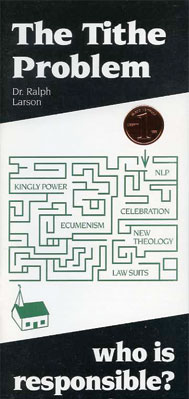
The Tithe
Problem Part I
Today the question
of accountable stewardship is becoming an issue in the minds of
many Seventh- day Adventists. The awareness that we all have an
individual accountability before the heavenly universe, to administer
the trust committed to us of God has, in recent years, raised questions
in our minds as to how to best fulfill that responsibility. It is
not the purpose of this paper to solicit funds, or to attempt to
point out what one's personal responsibility is, but to give our
readers information that will help them fulfill their position as
God's stewards.
The subject
of tithe has come to be an emotional mine field, and so let us proceed
with caution. Voices usually calm are likely to become strident
when the subject is introduced, and not infrequently, strongly stirred
feelings find expression in bitter accusations. Yet the problem
is real, and it is here. It shows no sign of diminishing, but rather
is steadily increasing. Ignoring it is not likely to be an adequate
answer, nor yet is indulging in emotional outbursts which tend to
aggravate tensions rather than to relieve them. Is it possible to
calmly consider this problem? Let us try.
My own exposure
to the problem has been educational. While I was teaching classes
of ministers in the Asian Adventist Theological Seminary I sometimes
met the question, “Is it ever proper to send tithe anywhere other
than through the regular church channels?” I answered the question
with a firm and uncompromising “No. Diverting the tithe to other
than the regular church channels could never, under any circumstances,
be the right thing to do.”
I must confess
that I did not give this answer because of evidence that I had seen,
but because of evidence that I was sure I would find in the Spirit
of Prophecy if I looked for it. However, since the question did
not seem to be an urgent one at the time, and I was very busy with
classes, evangelistic meetings, and other projects, I did not engage
in any research on this particular topic.
But upon returning
to the States in 1985 I was surprised to find that the question
was seriously troubling many church members. With full confidence
I set out to find the Spirit of Prophecy evidence that tithe should
always go through the regular church channels and never anywhere
else. This research brought my second and much greater surprise.
I did not find what I was looking for. It just was not in the inspired
writings.
Was I failing
to properly understand what I had read? Apparently not. I did find
a statement regarding the question that had been prepared by Willie
White (Ellen White's son and secretary), Elder A. G. Daniells, and
Elder W. W. Prescott, which indicated that neither had they found
such evidence in Ellen White's writings. The historical context
of their statement is as follows:
On May 9, 1907,
a Charles E. Stewart of Battle Creek sent to Ellen White's office
at Sanitarium, California, a 49- page compilation of questions and
charges intended to cast doubt on the Spirit of Prophecy as manifested
in her ministry. In October of the same year, the material was bound
into a small book and published, apparently in Battle Creek. At
some later date it was republished by another of Ellen White's critics,
E. S. Baflenger, of Riverside, California. Document WDF 213, in
the White Estate Office in Loma Linda, is a record of the plans
made by Willie White, Daniells, and Prescott to deal with the charges
in the book, one of which was that Ellen White's counsels and practice
in regard to the tithe were not consistent, in that she did not
always follow her own recommendations. Paragraph six on page two
of the document is a clear statement of how these brethren understood
the totality of Ellen White's teachings in regard to the paying
of tithe. “ 6. As to the proper use of the tithe: The outline of
a statement on this subject which was agreed upon was briefly this:
To give extracts from Sister White's writings as to the tithe and
its use; to show that her testimony and her own usual practice was
in favor of paying the tithe into the regularly designated treasury,
to be used under the counsel of the committees appointed for such
purposes; to show further from her writings that when those who
have charge of the expenditure of the tithe so far fail in the discharge
of their duty that the regularly organized channels for the distribution
of tithe become hindrances to its proper use, then in order to carry
out the divine plan that the tithe should be expended in the wisest
manner for the furtherance of the work, individuals have the right
to pay their tithes direct to the needy fields; but that this involves
a considerable degree of personal responsibility, which must be
assumed by those who decide to follow this plan. It was thought
that this matter could be handled in a way to show that the departure
from the regular plans was authorized only when the regular plans
failed to be carried out by those in positions of responsibility.”
This statement
appeared to be strong evidence that I had not misunderstood the
materials I had examined. The conclusions of these brethren were
not different from my conclusions, after my study.
As indicated
in the quotation, their purpose was to enlarge the outline into
a tract or paper on the subject. We would, no doubt, find it helpful
if we could read the paper itself, but I have not yet been able
to locate a copy.
Certain basic
points in regard to tithe paying stand out very clearly in Ellen
White's writings. She had no doubt that returning tithe to the I£
rd is a Christian duty, and that a failure to perform this duty
is tantamount to stealing from God (see Malachi 3). She is equally
clear and firm in her conviction that the tithe has only one proper
use, the support of the ministry of the Word of God. Although she
includes those who minister with pen as well as with voice, she
specifically excludes other forms of Christian endeavor, such as
“school purposes” and “canvassers and colporteurs” (See Testimonies,
vol. 9, 248- 249), a poor fund or church expense. See Counsels on
Stewardship, 103, and other references.
According to
the testimony of God's inspired messenger, tithe should always be
faithfully returned to the Lord, and all of the tithe should be
used for the support of the ministry. But which ministry or what
ministry? This is the question that is troubling us now. What if
a ministry strays from the path of sacred duty? What if a ministry
becomes so theologically confused as to depart from the truths of
God's Word and begins preaching a false gospel? What if church leaders
begin to use tithe funds for purposes other than the ministry of
the Word, such as those listed above, or even to pay the fees of
non- Adventist lawyers? What, then, is our Christian duty? We may
seek to escape from these troubling questions by shrugging them
off and saying, “There is no need for us to concern ourselves about
things like that. They could not happen in our church.” But in view
of Ellen White's predictions of a great Adventist apostasy, is this
a realistic attitude? Willie White, Daniells, and Prescott took
no such position. They did not deny the possibility of a malfeasance,
as indicated by these words:”. .. when those who have charge of
the expenditure of the tithe shall so far fail in the discharge
of their duty that the regular organized channels for the distribution
of the tithe become hindrances to its proper use . .
“When the regular
plans failed to be carried out by those in positions of responsibility
. . . .” Document WDF, 213
Let us remind
ourselves that these brethren were not expressing their own opinions.
They were setting forth what they understood to be the totality
of the teachings of Ellen White. They had before them the example
of Ellen White. In the year 1905, two years before their meeting,
Ellen White had written a letter to the president of the Colorado
conference in which she had revealed that “for years” she had been
using her tithe to assist needy ministers who were being neglected
by the organization. When this statement was first called to my
attention, I dismissed it very easily (I thought) by saying, “She
was a prophet, and I am not a prophet. God often gives instructions
to His prophets that do not apply to other people.”
But the matter
is not quite that simple. The letter also revealed that when other
persons offered her their tithe to use as she thought best, she
accepted it and used it as indicated above, in support of needy
ministers. Perhaps we could still say that she was exercising the
prerogatives of a prophet, since the money passed through her hands.
But that would
not be true of the third type of tithepayers who are mentioned in
her letter: “If there have been cases where our sisters have appropriated
their tithe to the support of the ministers working for the colored
people in the south, let every man, if he is wise, hold his peace.”
There is no
suggestion that this money passed through her hands, or that she
was consulted about it. The money was apparently sent directly to
needy ministers whose condition had become known to the tithepayers.
Ellen White obviously did not disapprove of the actions of these
persons, much less accuse them of “stealing” the tithe.
We must recognize
that Willie White, Daniells, and Prescott, who were charged with
the responsibility of setting forth a comprehensive statement regarding
Ellen White's counsel and practice regarding tithe paying, were
faithful to the evidence that was before them. They frankly reported
their findings to the people, with neither understatement nor overstatement.
They felt that there was no self- contradiction between Ellen White's
writings and her practice. In neither her writings nor her practice
was there any- thing to support the view that all tithe, regardless
of circumstances, must be paid through regular church channels.
It is probable
that they did not anticipate any great trouble for the church organization
as the result of the publishing their frank statement. The conditions
that they described as making it permissible, according to Ellen
White's writings, for a church member to exercise individual judgment
in deciding where to send tithe, (the failure of persons in places
of responsibility to use the tithe for its proper purpose) hardly
existed in their time, if they existed at all. These leaders could
not have been expected to foresee the conditions that have now developed
in the church as a result of the great Adventist apostasy that has
been the subject of this series of studies.
But church members
in our time could hardly be expected not to see these conditions.
Many have recoiled in horror from the revelation that hundreds of
thousands of dollars of sacred tithe funds have been used to employ
Catholic and other non- Adventist lawyers to sue and prosecute persons
for calling themselves Seventh- day Adventists, and in at least
one case assessing huge fines and putting the person in jail.
Some members
may not be aware of such specific incidents as this, but it would
be difficult for any member in the North American Division to be
unaware of the great theological apostasy which is the very heart
of the tithe problem. He or she is likely to encounter it in church
on any Sabbath morning.
It is an undeniable
fact that there are pastors in Seventh- day Adventist churches,
teachers in Seventh- day Adventist colleges, and persons at all
levels of church administration who are persistently presenting
as truth the devil's great lie, that Christians cannot stop sinning
even by the power of God. Ellen White has identified this assertion
no fewer than 35 times as a lie that originated in the heart of
Satan, and that was proved to be false by our Lord Jesus Christ.
Undoubtedly the strongest of her statements is this:
“Satan declared
that it was impossible for the sons and daughters of Adam to keep
the law of God, and thus charged upon God a lack of wisdom and love.
If they could not keep the law, then there was fault with the Lawgiver.
Men who are under the control of Satan repeat these accusations
against God, in asserting that men can not keep the law of God.
Jesus humbled Himself, clothing His divinity with humanity, in order
that He might stand as the head and representative of the human
family, and by both precept and example condemn sin in the flesh,
and give the lie to Satan's charges.” Signs of the Times, vol. 3,
264
May we suggest
a second thoughtful reading of the above inspired statement? Its
implications are staggering. Can it be possible that there are ministers,
teachers, and administrators all through our ranks who are under
the control of Satan? If the writings of Ellen White are inspired,
we have no choice but to believe it.
Here is the
heart of the tithe problem. Here is the answer to our question,
Who is responsible? Would it not be the ministers who present poison
from the pulpits, the teachers who present poison in the classrooms,
and the administrators who support and defend them, ignoring desperate
appeals from church members?
To blame the
tithe problem on independent ministries is as illogical and unjust
as to blame the historic Adventists for divisions being created
in the church by the preaching of the false doctrines of Calvinism
among us. May we here earnestly appeal for clear thinking and fair
judgment on this matter?
Consider the
problem of a church member who understands our message, is devoted
to the truth as it is in Jesus, and has always been a faithful tithepayer.
During the years he has built up a small library of Ellen White's
writings and has studied them with care. Then he is confronted with
a series of shocks.
On Sabbath he
hears his pastor proclaim that our Lord came to earth in the human
nature of the unfallen Adam, making Him very different from ourselves.
He finds it puzzling, and so spends some time on Sabbath afternoon
looking through his copy of The Desire of Ages. He finds the opposite
affirmed to be true on pages 25, 49, 112, 117, 174- 175, and 311-
312. Soon after, he hears his pastor preach that it is impossible
for Christians, by any means, to stop sinning and that it is impossible
for anyone to obey the law of God. In his The Desire of Ages the
church member finds this statement described as Satan's lie on pages
24,29, 117, and 761, and he finds in that volume a total of 78 statements
that it is possible, through the power of Christ for Christians
to obey God's law. He then turns to The Great Controversy and reads
on page 489 that “[ Satan] is constantly seeking to deceive the
followers of Christ with his fatal sophistry that it is impossible
for them to overcome.”
As this heart-
wrenching experience continues, the church member is eventually
forced to recognize that Ellen White's predictions about the great
Adventist apostasy are being fulfilled before his eyes. Then comes
the agonizing question, “Does God require me to pay my tithe to
support the great apostasy?”
Like many others
before him, he decides that this line of reasoning just doesn't
make sense. He then turns to an independent ministry holding the
Seventh- day Adventist historic faith, preaching the message that
he accepted when he joined the church. He now begins to send his
tithe to that ministry.
Now the question
for every fair- minded person to consider is, Who is responsible?
Has the church member's problem been created by the independent
ministry, or by the preaching of the false doctrines of Calvinism
in his own church?
And will this
problem be solved by crushing independent ministries and letting
the false preaching continue? The answer is self- evident. To destroy
the independent ministries will not solve the church member's problem,
nor will it be solved by cracking whips of church authority over
his head, excluding him from church office, or by any other means
of coercion.
Tragically,
this obvious truth seems to be lost on some church administrators
who continue to condemn and rail at independent ministries as if
they were the cause of all the difficulty, and that the solution
is simply to put them out of existence. It appears that some of
these ministries are now being threatened with church discipline
as a first step in that direction.
I have been
invited to several meetings ostensibly called for the purpose of
resolving tensions between independent ministries and the church
organization. At none of these meetings did I discern the slightest
recognition that the preaching of false doctrines in our churches
was the real problem, or even any part of the problem. At none of
them did I hear the slightest hint that any attempt would be made
to correct this evil. Rather, the message delivered to the independent
ministries is simple, “You, and only you, are the problem, and if
you do not stop what your are doing, in particular if you do not
stop accepting tithe, you are going to suffer the consequences.”
Some are already
suffering the consequences. Members of independent ministries have
in some places been denied the right to transfer their membership
either into or out of the churches where they live. It should be
remembered that transfers are a right of church membership and may
be denied, according to the church manual, only by properly conducted
church disciplinary actions. See pages 162- 163 of the Church Manual.
For that matter,
the Church Manual also recognizes the right of independent ministries
to exist (see page 158), and also provides that no church member's
standing should be called in question because of his failure to
give financial support to the church. See page 165
But strong emotion
is the enemy of reason, and as we noted at the beginning of this
study, emotions tend to run high when the tithe problem is mentioned-
so high that in some cases neither appeals to the Church Manual,
to the Spirit of Prophecy, or even to the Bible itself bring any
result.
Emotional tensions
also contribute to the mishandling of evidence found in various
public statements about tithe, and the accusations accompanying
them. Possibly the outstanding example of mishandled evidence is
a variety of Ellen White statements, written to show that tithe
should be used only for the ministry of the Word and not for other
Christian endeavors, are misconstrued to mean that tithe should
be paid only to one ministry of the Word and not to the other minis-
tries of the Word. An oft- quoted example of this misconception
is on page 247 of Testimonies, vol. 9:
“Let none feel
at liberty to retain their tithe, to use according to their own
judgment. They are not to use it for themselves in an emergency,
nor to apply it as they see fit, even in what they may regard as
the Lord's work.” Emphasis supplied
What Ellen White
meant by the clause “what they may regard as the Lord's work,” is
made clear on the following pages by these lines:
“One reasons
that the tithe may be applied to school purposes. Still others
reason that canvassers and colporteurs should be supported from
the tithe. But a great mistake is made when the tithe is drawn
from the object for which it is to be used— the support of the
ministers.” 248- 249
In view of
the general frailty of human nature, and the specific predictions
by Ellen White that there would be many apostates in the Seventh-
day Adventist ministry in the last days, (see Testimonies to Ministers,
409- 410; Testimonies, vol. 5, 80- 81, 707) it would have been
hazardous indeed for the messenger of the Lord to have singled
out any particular group of ministers as the only ones who should
ever be supported by tithe, and even more hazardous to maintain
that they must be supported by tithe regardless of what they might
be teaching or doing.
“It would
be poor policy to support from the treasury of God those who really
mar and injure His work, and who are constantly lowering the standard
of Christianity.” Testimonies, vol. 3, 553
“There are
fearful woes for those who preach the truth, but are not sanctified
by it, and also for those who consent to receive and maintain
the unsanctified to minister to them in word and doctrine.” Ibid.,
vol. 1, 261- 262
“As there
are woes for those who preach the truth while they are unsanctified
in heart and life, so there are woes for those who receive and
maintain the unsanctified in the position which they cannot fill.”
Ibid., vol. 2, 552
Let us take
note, also, of Ellen White's use of the expression, “the treasury
of God.” In her letter to the Conference president to which we have
already referred, she first tells of her practice and then adds,
“The money is not withheld from the Lord's treasury.” Obviously
she did not have the limited view of “the Lord's treasury” that
some have today.
Some independent
ministries have pointed out Ellen White's statements that it is
not necessary for all “funds” or “means” to flow through the same
channels, and since no exception is stated in regard to tithe, they
have concluded, not unreasonably, that these general terms include
both tithes and offerings. But some writers have seized upon this
conclusion and made it the basis for accusations of dishonesty.
Surely this accusation could be termed uncontrolled emotionalism.
We certainly want to have much stronger evidence before we accuse
any persons of being dishonest.
You and I cannot
solve the problems of the church nor the problems of the independent
ministries, but we can and must resolve our own personal and individual
problem in regard to the type of ministry that we support with our
tithe. This problem is best solved by each one of us on his knees
before the I£ rd, with the inspired writings before him. Probably
none of us should presume to instruct others as to their duty.
Some may think
of the widow and her two mites upon whom the Lord pronounced a blessing
in spite of the corruption among church leaders at that time.
Others may reflect
that we have no evidence that the widow was aware of the corruption,
and that in any case there was no representative church government
such as we have now. Some will be influenced by Ellen White's statement:
“God desires
to bring men into direct relation with . . . . . Every man has
been made a steward of sacred trusts; each is to discharge his
trust according to the direction of the Giver; and by each an
account of his stewardship must be rendered to God . . . . We
are responsible to invest this means ourselves.” Testimonies,
vol. 7, 176- 177
“Do we individually
realize our true position, that as God's hired servants we are
not to bargain away our stewardship? We have an individual accountability
before the heavenly universe, to administer the trust committed
us of God.” Testimonies to Ministers, 361- 362
And we must
not overlook the warnings previously quoted that there are woes
upon those who consent to receive and maintain ministers whose unsanctified
attitudes injure the work of God.
It has not been
the purpose of this study to give directions to any person as to
his individual responsibility. It has been our purpose to prove
the following points:
- There is
no biblical or Spirit of Prophecy evidence to support the view
that all tithe must, regardless of circumstances, be paid through
organizational channels. Such a position might in some cases require
that outright apostasy be supported by tithe, which is far beyond
the boundaries of reason.
- We have been
given through God's appointed messenger an abundance of clear
warnings that there would be a time when apostate ministers would
be preaching in many Seventh- day Adventist pulpits, and that
the apostasy would sweep through the ranks of our ministers and
our members.
- If we are
to take Ellen White's words at their face value, that time has
at least partially arrived, in that many ministers are now occupying
Seventh- day Adventist pulpits who are preaching as truth the
devil's great lie- that Christians cannot stop sinning even through
the power of Christ. By unmistakably clear Spirit of Prophecy
definition, such ministers are “under the control of Satan.”
Therefore, as
Christian stewards under God, we have a solemn responsibility to
fulfill in regard to our tithes and our offerings.
May the Lord
help each one of us to prayerfully, carefully, and conscientiously
return the sacred tithe, as the Lord has directed, for the support
of the ministry. May we never be confused and uncertain as to what
kind of ministry the Lord deems worthy to receive the tithe. And
may we never be confused or uncertain as to who is responsible for
the present tithe problem. The responsibility must be placed squarely
at the doors of those who are preaching among us the false doctrines
of Calvinism and the administrators who are supporting and maintaining
them in their positions.
The messenger
of the Iord counseled parents, guardians of youth, and those who
minister in the service of God:
“When existing
evils are not met and checked, because men have too little courage
to reprove wrong, or because they have too little interest or
are too indolent to tax their own powers in putting forth earnest
efforts to purify the family or the church of God, they are accountable
for the evil which may result in consequence of neglect to do
their duty. We are just as accountable for evils that we might
have checked in others, by reproof, by warning, by exercise of
parental or pastoral authority, as if we were guilty of the acts
ourselves.” Testimonies, vol. 4,516
May God give
us faith, courage, and power in these troubled times to know and
do the will of the Lord.
Part 2
The editors of
the Adventist Review have taken notice of the questions about tithe
that are troubling an increasing number of our church members and
have published in their edition of September 7, 1991, a supplement
in the form of an inserted tract dealing with the subject.
This development
is most welcome. It is hoped that the Review editors will continue
this enlightened policy, and that they will apply it to the other
areas of concern that are as troubling to our members as the tithe
question, if not more troubling.
We suggest that
every church member who has a sincere desire to know and to do God's
will, will do well to save this special insert and compare it with
the article on tithe in the September issue of Our Firm Foundation,
as well as with this article.
We are confident
that only good can come from such a comparison. let every church
member examine the evidence and draw his or her own conclusions.
Here the matter must ultimately rest, as was recognized by Ellen
White in a thought- provoking statement on page 616 of The Desire
of Ages:
“The
Jewish rulers recognized the obligation of tithing, and this was
right; but they did not leave the people to carry out their own
convictions of duty.”
It is to be
hoped that all concerned parties will remember that church members
cannot be forced to pay tithe. They must act out their own convictions
in the matter, and these convictions will grow out of their satisfaction
with the scriptural and the Spirit of Prophecy evidences placed
before them. Scoldings and threatenings will not suffice, and church
discipline on this point is specifically forbidden in the church
Manual. See page 240 in the 1971 edition and page 165 in the 1986
edition
We, therefore,
welcome the decision of the Review editors to bring the subject
out into the open, so that church members may be provided with the
opportunity to weigh evidence, evaluate arguments, and develop their
own convictions of duty.
Basic Principles
Before considering the specifics of the situation, let us identify
some landmarks and fixed boundaries, basic principles that must
apply to any and all of the details. The most important and relevant
truth that must be kept in mind throughout all of our study is:
“It should be
remembered that the promises and threatenings of God are alike conditional.”
- Selected Messages, book 1,67 The experience of the Israelites,
who were once the chosen people of God but were eventually rejected
as a people by God, testifies eloquently to the truth of this statement.
The opinion that prevailed among the Jews of Christ's time was that
regardless of how far they departed from the express will of God,
they nevertheless retained their position as the chosen people of
God, with all of the rights and privileges pertaining thereto. This
conviction was in spite of such clear warnings as had been given
in Leviticus 26, Deuteronomy 28, Jeremiah 18, and elsewhere.
Here is the
crux of the matter. The questions that we must consider are these:
Could it be possible that the error of the Jews might have, to some
degree, crept into our thinking? Are we beginning to believe that
we are unconditionally the true church of God? Are we presuming
that the rights and privileges of a true and faithful church are
ours unconditionally? That the promises of God are without condition?
Are we supposing
that the rights and privileges of a true and faithful ministry can
be claimed by our ministry unconditionally? That they have a right
to collect tithe regardless of what they teach and do?
Doubtless we
would find these questions easier to answer if they were expressed
in terms of totality— total rejection of all of the will of God
by all of the ministers of our church. We would quickly agree that
such is not the case. But does that resolve our problem? Was there
not always a faithful remnant in Israel? And do we know of any church
today that rejects all of God's truth? Yet, God rejected Israel,
and we know God is calling His people out of the popular churches
of our time.
Is it not apparent
that there is a line beyond which infidelity may not pass with impunity?
A line beyond which neither a church nor a ministry can claim for
itself the rights and privileges that God has guaranteed to a faithful
church and to a faithful ministry? We must remember the promises
and the threatenings of God are alike conditional.
We come now
to the question, How should we see our church and its ministry today?
The Review tract writer suggests that there is a significant difference
between saying there is apostasy in a church and saying a church,
speaking of the entire body of believers, is in apostasy. This point
is well taken. I know of only one independent ministry leader who
has a conviction that the church is in apostasy. The rest would
say, like the Review tract writer, that there is apostasy in the
church, although they would not minimize it as he does.
I have received
a letter from a Union Conference president which opens with this
sentence: “I despair with you over the fact that so many of our
church members are finding it necessary to turn to independent ministries
in order to hear basic Adventist teaching.” And I would recommend
for thoughtful study the Annual Council 1973/ 1974 Appeals for reform
as published in Our Firm Foundation in December 1991.
The precise
point in increasing apostasy at which it would be appropriate to
stop saying there is apostasy in the church and start saying the
church is in apostasy is a difficult problem. It is doubtful that
human wisdom is sufficient for the question. Probably it would be
best to let that point be defined by the Divine Mind that never
errs in judgment.
But the questions
that are coming to me from all across the country are from church
members who are facing an immediate, practical problem. They are
being forced to recognize that some of the doctrines being presented
in their particular churches are very different from the doctrines
they were taught when they joined the church or when they attended
Adventist schools. Many recognize the strange doctrines as the very
errors they left behind when they withdrew from other churches in
order to become Seventh- day Adventists.
These members
do not wish to return to those errors, nor have them taught to their
children. Many have made fruitless appeals to church pastors and
administrators. These are the kind of people who are turning in
despair to ministries which are teaching the unchanged Seventh-
day Adventist faith. These are the kind of people who are asking
the urgent question, “Does God require me to pay tithe to support
the teaching of false doctrines? Would it be wrong to pay tithe
to a ministry that teaches the faith that I believe?”
I sympathize
with them, although I do not presently share their problem. The
church where I hold membership is served by a pastor who preaches
the historic Seventh- day Adventist message, and so I am comfortable
paying tithe and offerings to this church. If this pastor were transferred
and a Calvinistic Adventist pastor put into his place, I do not
know what I would do. I hope that I never have to face the problem.
But others are facing the problem.
These questions
are what caused me to do the research that was reported in Our Firm
Foundation, September 1991. I set forth my conclusion in this statement:
“In
neither Ellen White's writings nor her practice was there anything
to support the view that all tithe, regardless of circumstances,
must be paid through regular channels.”
The writer of
the Review tract article challenges this conclusion and sets forth
a series of arguments in support of the view that all tithe must
be paid through the regular church channels, apparently regardless
of circumstances. He sees it as the correct understanding of Ellen
White's writings on the subject.
For purposes
of analysis, we will group his arguments as follows:
- Argument
from the Scriptures
- Arguments
from the Spirit of Prophecy
- Arguments
regarding Document File 213
- Arguments
based on supernatural powers
- Arguments
ad hominem, against the man
- Theological
questions
Argument
From the Scriptures
We use “argument”
in the singular form because there is only one scriptural argument
presented:
“The Old Testament
gives clear instruction for the return and use of the tithe. The
New Testament does not elaborate further, except to endorse the
necessity of tithe paying.” Page 2
Let us compare
this statement with 1 Corinthians 9, in which the apostle Paul responds
to questions about his credentials and his right to the financial
support of the people. The general principles set forth in the first
twelve verses are brought to a specific conclusion in verses 13
and 14:
“Do ye not know
that they which minister about holy things live of the things of
the temple? And they which wait at the altar are partakers with
the altar? Even so hath the Lord ordained that they which preach
the gospel should live of the gospel.”
Verse 13 is
an obvious reference to the tithing system, by which the Levites
were supported. Verse 14 specifically applies the same principle
to another group. And who are they? “They which preach the gospel.”
Their credentials
are the gospel which they preach. And was Paul a pluralist? Was
he saying that preachers of any gospel and all gospels are to be
supported by the tithe? We will find the answer in Galatians 1:
8- 9:
“But though
we, or an angel from heaven, preach any other gospel unto you than
that which we have preached unto you, let him be accursed. As we
said before, so say I now again, If any man preach any other gospel
unto you than that ye have received, let him be accursed.”
Does “let him
be accursed” equate with “Let him be supported by the tithe?” And
notice that Paul includes even himself in the warning, saying “Though
we preach any other gospel unto you....” Is he not putting the test
of truth above all other tests? Is he not telling them that the
true gospel is the highest of all credentials? So much so that they
should refuse to listen to even Paul himself if he came back to
them preaching a different gospel, a new theology? How, then, can
it be argued that if a minister is a member of a certain church
and carries credentials from that church, he is entitled to be supported
by the tithes of God's people regardless of what gospel he preaches?
Arguments From
the Spirit of Prophecy Unfortunately, much of the material in this
area is wasted, because it does not deal with the question before
us. The longest series of Spirit of Prophecy quotations presented
are warnings against withholding tithe, a practice which no one
is defending. All of the parties involved in the present discussion
believe that tithe paying is a sacred duty. None would approve of
withholding it.
Similarly, much
attention is given to the Spirit of Prophecy counsels regarding
the proper use of the tithe to support the ministers of the gospel,
a matter concerning which there is no significant disagreement.
All of the parties involved are committed to following these inspired
counsels, although in his list of the proper uses of the tithe,
the writer might have included this instruction: “But while some
go forth to preach, He calls upon others to answer to His claims
upon them for tithes and offerings with which to support the ministry,
and to spread the printed truth all over the land” Testimonies,
vol. 4, 472; emphasis supplied in all quotations
Emphasis in
the Review tract is placed upon a caution against any person “gathering
up tithes,” which I would understand to mean solicitation. I do
not know of any independent ministry that solicits tithe. Tithe
comes to the independent ministries voluntarily from church members
who are weary of false teachings being presented in their particular
churches. Most of these church members have been faithful tithe
payers for many years. Their devotion and fidelity to this Bible
truth is not different from their devotion and fidelity to the other
truths of our faith which they cannot bear to see changed. Where
truth is taught, tithe is paid. That is the bottom line.
A strong attempt
is made to apply Ellen White's warnings against withholding tithe
to the payment of tithe through other than the regular church channels.
Two lines of reasoning are set forth in support of this proposition.
First, it is
argued that for Ellen White the expression “the Lord's treasury”
meant only church and conference treasuries. This statement is in
spite of the fact that when she herself sent tithe directly to needy
ministers, and not through church or conference treasuries, she
wrote, “The money is not withheld from the Lord's treasury.” (The
Watson letter, quoted in Review tract, page 13.) How, then, can
it be maintained that for her “the lord's treasury” meant only church
and conference treasuries?
The Review tract
writer apparently anticipated this question and offered what is,
to my mind' a very unsatisfactory explanation. After having admonished
us that for Ellen White “the lord's treasury” meant always and only
the church and conference treasuries, he then tells us that when
Ellen White's tithe was sent directly to needy ministers, bypassing
church and conference treasuries, it was not withheld from the lord's
treasury because they were Seventhday Adventist ministers.
Readers may
decide for themselves whether this attempt to walk on both sides
of the street at once is persuasive. Would not this interpretation
open the door for all of us to bypass church and conference treasuries
and send our tithe directly to needy ministers of our choice?
The second line
of reasoning advanced in support of the claim that for Ellen White
“the Lord's treasury” meant only church and conference treasuries
is that for Ellen White the word “means” does not generally include
tithe but is applied only to offerings. Since only this argument
was new to me, I checked it out carefully, and quickly discovered
that the claim does not bear up well under investigation.
I went to that
marvelous invention, the “CD Rom,” as produced by the White Estate,
and asked it to report whether in Ellen White's writings the words
tithe, tithes, tithing, and tenth, were ever used in connection
with the word means. It promptly supplied 168 references in which
these words were used in such a manner as to make it impossible
to separate them from the word means, which obviously included them.
In some passages tithes and offerings together are referred to as
means, and in other passages tithe alone is referred to as means.
For the sake of brevity, we will provide here a sampling of those
statements that do not include offerings: “Every soul who is honored
in being a steward of God is to carefully guard the tithe money.
This is sacred means.” Manuscript Releases. vol. 1, 185
“There are a
large number of names on our church books; and if all would be prompt
in paying an honest tithe to the lord, which is His portion, the
treasury would not lack for means.” Counsels on Stewardship, 95
“Of the means
which is entrusted to man, God claims a certain portion- a tithe.”
Testimonies, vol. 5, 149 “God has given special direction as to
the use of the tithe. He does not design that His work shall be
crippled for want of means.” Gospel Workers, 224
“Should means
flow into the treasury exactly according to God's plan- a tenth
of all the increase, there would be abundance to carry forward His
work.” Evangelism, 252
“And in view
of this the Lord commands us, 'Bring ye all the tithes into the
storehouse, that there may be meat in mine house; ' that is, a surplus
of means in the treasury.” Review and Herald, vol. 2, 18
“If all of our
people paid a faithful tithe, there would be more means in the treasury.”
Ibid., vol. 4, 507
“With an increase
of numbers would have come an increase of tithe, providing means
to carry the message to other places.” Pamphlet No. 67,9
“If all, both
rich and poor, would bring their tithes into the storehouse, there
would be a sufficient supply of means.” Testimonies, vol. 4, 475
Since Ellen
White went into print 168 times with statements clearly identifying
tithes as means, (sometimes using duplicate words), it is difficult
to understand how the Review tract writer could have reached an
opposite conclusion. And since his representation that for Ellen
White the expression “the lord's treasury” means only church and
conference treasuries is not supported by either of the two evidences
he offers, it collapses of its own weight. It deprives of all validity
the attempt to apply Ellen White's warnings against “withholding
tithe” to those who do not withhold tithe but, rather, send it to
ministers that they feel are faithful to our message. And it gives
particular force to her statement:
“All the means
is not to be handled by one agency or organization.” Spalding- Magan
Collection, 421
Arguments Regarding
Document File 213 As was stated in my article in Our Firm Foundation,
September 1991, this file contains a record of the plans that were
made by Willie White, Ellen White's son and secretary; General Conference
President A. 0. Daniells; Elder W. W. Prescott; and others to deal
with criticisms of Ellen White that had been published by a Dr.
Stewart in the year 1907. Stewart had charged Ellen White with inconsistency
in that she recommended paying tithe through organizational channels,
yet did not always follow her own counsel. Their proposal for dealing
with the challenge was set forth in these words:
“As to the proper
use of the tithe: the outline of a statement upon this subject which
was agreed upon was briefly this: to give extracts from Sister White's
writings as to the tithe and its use; to show that her testimony
and her own usual practice was in favor of paying the tithe into
the regularly designated treasury, to be used under the counsel
of the committees appointed for such purposes; to show further from
her writings that when those who have charge of the expenditure
of the tithe so far fail in the discharge of their duty that the
regularly organized channels for the distribution of the tithe become
hindrances to its proper use, then in order to carry out the divine
plan that the tithe should be expended in the wisest manner for
the furtherance of the work, individuals have the right to pay their
tithes direct to needy fields; but that this involves a considerable
degree of personal responsibility, which must be assumed by those
who decide to follow this plan. It was thought that this matter
could be handled in a way to show that the departure from the regular
plans was authorized only when the regular plans failed to be carried
out by those in positions of responsibility.”
The Review tract
writer tries to offset this evidence by the following methods: First,
doubt is cast upon the authorship and dating of the document. I
see no reason for such doubts. The file contains four letters from
Dr. Stewart on the subject, all addressed to Willie White. There
is also a letter of response from Willie White to Dr. Stewart. The
notes, or “memoranda,” contain ten references to Willie White as
the one who should answer certain questions. The most significant
of the ten for the purposes of our inquiry is
“Tithe— to whom
it should be paid: “Refer this to W. C. White. Very important.”
In the light of this evidence it appears that to question Willie
White's involvement in the proceedings is hardly reasonable. And
to question the date is not more reasonable. The four letters if
of Dr. Stewart to Willie White are dated October 22, 1906; May 8,
1907; June 10, 1907; and June 24, 1907. Willie White's letter to
Dr. Stewart is dated June 9, 1907. The book by Dr. Stewart was published
in mid- October, 1907, and a copy was sent to Willie White on October
27, 1907. The “memoranda” which includes the statement about tithe
makes specific reference to this book. These facts seem to adequately
establish the date for all practical purposes.
Second, the
Review tract writer proposes that these men did not properly understand
Ellen White's thinking regarding the tithe, and supports this proposal
with a most unhelpful comparison. He refers to a vision of heavenly
planets given to Ellen White in 1846 in the presence of James White
and Joseph Bates, who assumed that she was seeing Jupiter, Saturn,
and Uranus. Then, we are told:
“Closeness to
a prophet does not guarantee correctness.” We are asked to accept
this as evidence that Ellen White's son Willie, who had been her
personal secretary and companion for twenty- six years, did not
understand her thinking regarding the tithe, a matter concerning
which she had gone into print well over a thousand times. The Review
tract writer, viewing the situation from a distance of more than
80 years, seems to feel he has a better understanding of her thinking
than Willie White did.
This reasoning
strains the credulity to the breaking point.
Another attempt
to discredit Document File 213 will be commented on in section 4.
Before leaving this section we must mention a puzzling question
and answer found on page 5 of the tract:
Q. “I've
heard it said that other women who joined Mrs. White in her 'tithe
project' for the Southern ministers didn't send their tithe through
Mrs. White but sent it directly to needy ministers, and that she
must have approved of such actions. Is this so?”
A. “No.”
(Followed by a lengthy explanation.) I do not understand how the
writer proposes to harmonize this statement with the following lines
in the Watson letter, which appears on page 13 of the Review tract:
“If there have
been cases where our sisters have appropriated their tithe to the
support of the ministers working for the colored people in the South,
let every man, if he is wise, hold his peace....
“I commend those
sisters who have placed their tithe where it is most needed to help
do a work that is being left undone.”
Especially puzzling
is the writer's recommendation that “the only safe course to follow,
as regards Mrs. White's position on the tithe question, is to let
her speak for herself.” Page 6
Why, then, should
the writer pose two questions about Ellen White's writings (on pages
5 and 6) and refer us to two interpreters of Ellen White's writings
for the answers? We are reminded of her own words:
“My Instructor
said to me, Tell these men that God has not committed to them the
work of measuring, classifying, and defining the character of the
testimonies.” Selected Messages, book 1,49
I intend no
disrespect to anyone, but I prefer to look at Ellen White's writings
with my own eyes and not through the eyes of another.
Arguments Based
on Supernatural Knowledge On page six of the tract we find two statements
that go far beyond human knowledge and could only be made by persons
who are writing with supernatural wisdom of some kind.
In the first,
a White Estate archivist makes reference to the Document File 213
and writes: “The Watson letter is the only Ellen White statement
from which they formed their conclusions.” Compare this with some
lines from the statement itself: “To give extracts from Sister White's
writings.... To show that her testimony and her own usual practice.....
To show further from her writings.”
We see here
no indication that they considered nothing but the Watson letter
In the absence of such an indication, to state what they did or
did not consider would require supernatural knowledge.
On page 6 of
the tract we find this bold statement: “And it is an undeniable
fact that Mrs. White never counseled anyone to place his or her
tithes anywhere except in the denominational 'treasury.” '
This is breathtaking.
How could any human being know with such certainty what Ellen White
never did? Only by supernatural knowledge. A logician would point
out that nothing can be proved by the absence of evidence. It would
be more accurate and more modest for a writer to state that he had
found no evidence of such counsel in the written records. But, to
firmly state as an “undeniable fact” that she never gave any such
counsel would surely require godlike powers.
Similar in nature
is the bold statement on page 9 of the tract: “Ellen White never
even considered such an option.” How can any human being state with
such assurance what another person has or has not considered? Would
not this require supernatural knowledge?
On page 10 the
Review tract writer does not hesitate to tell us what Ellen White
intended and on page 15 he explains to us what Ellen White had in
mind on a certain occasion. All of this requires powers that are
not possessed by ordinary humans. Most of us would have to admit
that we are not able to read the minds of our contemporaries, much
less the minds of persons who died long before we were born. Surely
such statements should be regarded with extreme caution.
Arguments Ad
Hominem A long established principle of discussion is that those
who have evidence will present their evidence, whereas those who
do not have evidence will attack the man. This is called the argument
ad hominem, against the man, also expressed in the statement:
“As evidence
decreases, vehemence increases.” It is to be regretted that the
Review tract writer makes several references to those who “solicit
or accept” tithe. As stated earlier, I have never heard of any ministry
that solicits tithe. Also as stated before, tithe comes to independent
ministries unbidden from distressed and disenchanted church members.
Ellen White herself did not reject such tithe. (See the Watson letter.)
Neither have
I ever heard of anyone who accuses the church of being in apostasy
simply because of a different view regarding the human nature of
Christ. See “Theological Questions” below. For the evidence which
causes most historic Adventists to reject the author's reasoning
about the human nature of Christ, we refer the reader to our 365-
page research report, The Word Was Made Flesh, available from Hope
International.
When a writer
proposes that he will present to us a “fair reading” of Ellen White's
writings (page 11), he is alleging that only an unfair person could
understand the matter differently than he does.
And to suggest
or imply that persons who quote a portion of a long statement have
sinister purposes m mind is again to lay claim to supernatural abilities
to read minds and to judge motives.
Since Ellen
White strongly indicated in the Watson letter that she preferred
that her personal handling of tithe funds not be widely advertised,
it is alleged that persons like myself who have made reference to
the letter are at fault. This allegation overlooks the fact that
the entire letter has been published twice by the White Estate itself,
in 1987 in Manuscript Releases, Vol. 11, pages 99- 100, and in 1981
in Elder Arthur White's Ellen 0. White: The Early Elmshaven Years,
pages 3953%. To fault those who now make reference to it is hardly
candid.
The tendency
to use the argument against the man reaches its climax on page 7,
where it is proposed that it may eventually be discovered that
(1) “Those who
now take the position that the church has apostatized were themselves
guilty of apostasy.”
We respond again
that the vast majority of the thousands of members who are calling
for the church to return to its pure teachings are not saying that
the church has apostatized. They are saying there is apostasy in
the church, which the Review tract writer himself concedes (page
3). And we take exception to the writer's definition of these people's
views about God's storehouse:
(2)... “teaching
others that God's 'storehouse' today is the treasury of any place
where Sabbath- keeping religious work for Christ is being performed.”
I have never
heard of any person who would so describe the storehouse. To so
characterize those who are pleading for the church to hold to all
of the doctrines of our historic faith, including the sanctuary,
the three angel's messages, and so on, is not appropriate.
I must commend
the Review tract writer, however, for not indulging in the type
of argument “against the man” that some others are employing. The
allegation is that those who are appealing for the church to heed
and follow God's counsels are setting themselves up as “more holy,”
“holy ones,” “pious critics,” “the only ones who are right.” These
allegations constitute the nadir, in my opinion, of the arguments
against the man.
It is left to
the considered judgment of the reader how well the cause of truth
is served by such allegations as these. As for the Review tract
writer's attempt to apply the principle of Matthew 18: 15 to the
present problem in the church, I refer the reader to Testimonies,
Volume 2, page 15, where it is emphasized that Matthew 18: 15 applies
to personal injuries, not church problems.
The Review tract
writer does not seem to allow for an independent ministry to be
legitimate and loyal unless it is to some degree under the supervision
and/ or control of the church organization. This is similar to the
views expressed in the eleven demands that were made upon independent
ministries some time ago. According to P. T. Magan, who with E.
A. Sutherland was a co- founder of Madison College, Ellen White's
views were a bit different. From Magan's copious diaries we excerpt
a few lines:
August 8, 1904:
“He [E. A. Sutherland?] says that he worked with W. C. White during
the forenoon getting articles and plans ready regarding the incorporation
of the school at Nashville. In the afternoon he met with Daniels,(
the General Conference president,) Prescott, (field secretary of
the General Conference,) Griggs, Washburn, Byrd, and W. C. White
to consider our plan of organization. Daniels did not like it.”
As later entries
in the diary indicate, the Spirit of the Lord was giving instructions
through Ellen White to the founders of Madison College which the
General Conference president did not like. August 9, 1904: “Talk
with Mrs. E. G. White and W. C. White regarding our plans for organization.
She said we were not to go under the dominion of the Southern Union
Conference.”
August 14, 1906:
“Spent forenoon with Daniels. Told him why our school was independent
and would have to eat showbread.” May 7, 1907: “Talked with Sister
White regarding attitude of General Conference toward us. Mrs. Sara
McEnterfer and Lillian present. Told Sister White about the administration
view that we had no right to go and get money unless we were owned
by the conference. She replied: “You are doing double what they
are. Take all the donations you can get. The money belongs to the
Lord and not to these men. The position they take is not of God.
The Southern Union Conference is not to own or control you. You
cannot turn things over to them.”
May 14, 1907:
“I talked to her [E. G. White] about the General Conference position
that concerns non- conference owned should have no money. She answered:
'Daniels and those with him are taking a position on this matter
that is not of God. '”
May 23, 1907:
“Spent the forenoon with W. C. White. He gave me Sister White's
letters to Daniels regarding us. He told me he did not agree with
the administration at Washington in insisting that all monies pass
through their hands. Said that he would not agree to our going under
conference domination.”
As is noted
by the Review tract writer, Ellen White served as a board member
of Madison College. This would seem to indicate that in her view
an institution and/ or a ministry could be totally independent from
the church organization and still be approved by. the Lord. But,
as in Ellen White's time, this view is still not appreciated by
some of our church administrators.
Theological
Questions Although we have already pointed out that the heart of
the present tithe issue is a theological problem, the theological
points raised by the Review tract writer have been purposely deferred
to this section for comment.
After conceding
that there is apostasy in the church, the Review tract writer strangely
takes no notice at all of the fact that this apostasy is the immediate
and urgent concern of probably 95 percent of the people whom he
is trying to correct. This apostasy is the specific reason for the
redirection of their tithe.
Instead of dealing
with this problem, the writer addresses his remarks toward a minuscule
group who may be guilty of various charges that he directs at them.
This tactic is not helpful to the thousands of church members who
are not doing the things that he deplores, but who are deeply concerned
about the increasing apostasy in the church. Their question is,
Why does he not address our problem? Why doesn't he talk to us?
And I wish to
address to the Review tract writer, as well as to all others who
have expressed similar concerns, the same question: Why don't you
talk to us? Why do you tilt at windmills? Why do you flog dead horses?
Why do you focus on the symptoms and ignore the disease? Why do
you set up straw men and then beat them to pieces while we can only
look on in wonderment?
The vast majority
of church members who are variously known as “historic Adventists,”
“Independents,” and so forth, do not recognize themselves at all
in the pictures often painted. The Review tract writer sets out
to fault and hopefully correct certain persons whom he apparently
suspects of evil purposes toward the church. He identifies these
persons by three characteristics which he vigorously condemns:
- Solicitation
of tithe,
- Saying that
the church is in apostasy, and
- Basing the
above accusation on a view of the nature of Christ. When the writer
repeatedly describes the offenders as persons who solicit tithe,
we can only respond that we do not know of whom he is speaking.
I, personally, have never heard of any person who solicits tithe.
When the writer
faults persons who say the church is in apostasy, we wonder, “To
whom is he referring?”
And when the
Review tract writer takes aim at persons who allegedly set forth
a different view of the nature of Christ as the basis of their accusation
that the church is in apostasy, we ask again, “Of whom is he speaking?”
I have never heard of such persons.
The people to
whom I minister have enormously larger concerns. They are witnessing,
for example, rejection of our sanctuary doctrine, the introduction
into our church of false Calvinistic doctrines of justification
and sanctification, rejection of the Spirit of Prophecy, and a general
lowering of the church standards. They are not helped by the singling
out of the nature of Christ as if that were the only issue.
We pause to
point out that the true doctrine of the nature of Christ is set
forth in the new Seventh- day Adventists Believe, pages 37- 56.
Check and see. The Review tract writer places before us an unhelpful
comparison of the present apostasy with the pantheistic apostasy
of Dr. J. H. Kellogg. We must remember that Kellogg's apostasy was
met head- on. It was not ignored until apostasy had spread through
a large portion of the church, as is happening today. A. 0. Daniels,
General Conference president at the time, used the power and influence
of his office to defend the truth and to oppose the error. We look
in vain for such decisive action today, in spite of clear Spirit
of Prophecy counsels that apply to both apostasies.
There is a crying
need for communication on the part of our church leaders, a communication
that includes some attentive, open- minded listening. There are
mountains of misunderstanding.
I am finding
it more and more difficult to persuade the historic Adventists to
whom I minster that the misinformation that is being constantly
circulated about them is done in ignorance and not with malice.
It is not easy to explain to those who want only to believe and
practice the faith that they accepted when they joined our church
why they should now be called divisive, controversial, troublemakers,
legalists, rightwingers, destructive critics, attackers of the church,
and so forth. They see these epithets as grossly unfair, untrue
allegations. I believe that any impartial court would agree with
them. Surely any fair- minded person would agree that those who
are promoting theological changes are the ones who produce division,
and those who resist theological changes should not be so accused.
To represent those people as attacking the church is absurd. To
call for a church to be true to the counsels of the Lord is surely
not attacking the church.
We now come
to my strongest point of disagreement with the Review tract writer.
He presents the following question and answer:
Q. “I
recently read that the SDA church leadership is out to resolve its
'tithe- problem' by 'crushing' and 'destroying' independent ministries
that are doing a lot of good. Is this so?”
A. “The
answer is No.” (It is followed by a lengthy explanation.) I do not
question the sincerity of the writer, but I do not find it possible
to accept this answer. At a camp meeting in the Northwest in 1991,
a speaker who represents our church administration at its highest
level unburdened himself of some opinions about independent ministries.
When audio tapes of his messages were sent to me, I listened in
deep sadness to language that was inaccurate, intemperate, and highly
inflammatory. When copied to typewriter paper, the tirade filled
two pages single- spaced, and ended with an appeal to his hearers
to “deal with” the offenders in their local churches.
The speaker
apparently was not even aware of his inappropriate use of the word
“new” to describe the views regarding the nature of Christ that
are held by most of the historic Adventists. There are 1200 statements
from pre- 1950 Seventh- day Adventist writers, including 400 from
Ellen White, to support the position that the historic Adventist
view is the “old” and the Calvinlstic view is the “new.” Sadly,
the speaker seems to regard these 1200 statements as “snake- oil.”
I know of no
independent ministry whose books are not audited. I know of no independent
ministry that pays anyone a yearly salary of $100,000 or more. Far,
far from it. All of the independent ministries of my acquaintance
are legally registered as nonprofit corporations and can provide
donors with full accountability in the form of tax- deductible receipts.
I know of no independent ministry that is trying to divide or destroy
the church. Many independent workers are former denominational workers,
intensely loyal to the church, who feel called to the work they
are doing.
When a church
administrator compares certain Seventh- day Adventists to the butchers
of Auschwitz and Dachau who exterminated millions of Jews, I feel
that we are forced to recognize that it is an attempt to fan the
flames of passion against those church members, preparatory to disfellowshiping
them. Already it seems that some other church leaders are taking
the cue and are adding fuel to the flames.
But will this
injustice crush and destroy the faith of those who do not wish to
change their theology? I doubt it. It might even cause that faith
to grow and to multiply. It has happened before in the history of
religion.
A retired Union
Conference president said to me recently, “I hope the brethren will
not forget that our conservative members are the financial backbone
of our church.” This point is worthy of reflection.
To summarize
and to state the problem in simple terms: The Seventh- day Adventist
church today contains three groups of church members. At one end
of the spectrum is a group who know very well what they are doing.
They are working vigorously to change the doctrines of our church
and with the flexibility of method provided by their theological
principle that God does not expect anyone to stop sinning. Hence,
the misrepresentations, false allegations, and so on.
At the other
end of the spectrum is another group who know very well what they
are doingtrying to preserve in their purity the doctrines of our
church and to prepare a people for the coming of the Lord. In spite
of bitter opposition and misrepresentation, this group is growing
very rapidly.
In the center
of the spectrum is a third and larger group who apparently have
not yet comprehended what the tensions are about, or who lack the
courage of their convictions.
Over all preside
our church administrators, most of whom seem to be looking on, either
benignly or indifferently, while attempts are being made to change
our theology, from time to time issuing piteous pleas for unity
which can only remind us of the Ellen White warning:
“We are to unify,
but not upon a platform of error.” Special Testimonies, Series B,
No. 2, article “Freedom in Christ,” 47
And we are presently
witnessing what appears to be an orchestrated propaganda campaign,
conducted for the purpose of fanning the flames of prejudice against
historic/ independent church members, preparatory to disfellowshiping
them from the church.
So— the historic
Adventists continue to ask, “Why will nobody talk to us? Why can
we not even be granted a fair hearing? Why are we being so continuously
misrepresented and falsely accused? And why do those who thus deal
with us yet think they have a right to demand our tithes and offerings?”
I submit that
these are valid questions. Since this article began with questions
about tithe, let me conclude it with some final thoughts on that
subject. Recently I sat in a meeting with a thousand other church
members and listened to a General Conference representative repeatedly
denounce “the independent ministries who are draining off the church's
money.”
I listened in
silence, but the language of my heart was, “Get real, Brother. Get
real.” I had heard in my own church a pastor say that televangelist
Jerry Falwell counts Seventhday Adventists as his second largest
group of financial supporters. It was stated that the source of
this information was a Union Conference secretary. I telephoned'
the secretary, and he verified the report. He had heard it from
Falwell's own lips.
The Union secretary
added that an Adventist Church member who had spent some time working
with televangelist Pat Robertson's organization reported the same
was true there. When we remember that these men count their receipts
in many millions of dollars per year, we have to recognize that
the portion they receive from Seventh- day Adventists, their second
highest donor group, must also be measured in millions. It is doubtful
that the combined budgets of all the Adventist independent ministries
would equal what even one of these televangelists is collecting
from Seventh- day Adventists each year.
Why is nobody
asking why? Why do so many of our leaders seem to be unaware of
the malaise that is affecting so many of our churches, where so
few messages from the pulpit reflect any sense of the urgency of
our task? Is it any wonder that church members, who have never doubted
that our Creator is a loving, caring God, (a message they could
hear in most nonSeventh- day Adventist Christian churches) grow
weary of hearing this truth endlessly repeated, and turn to preaching
that seems to have more immediate significance?
Preaching the
wonderful love of God we must do, but not leave the other undone.
Let us remember that if Noah had done nothing but preach about a
loving, earing God, there would have been no ark and his family
would have perished in the Flood. If Moses had done nothing but
preach about a loving, caring God there would have been no deliverance
of God's people from the land of bondage. If we do no more than
preach about a loving, caring God, it will be necessary for God
to raise up another people to take the three angels' messages to
the world. Our loving, caring God is a God of action, and His saving
action for this world is in its final stages. The last warning message
must go to the world. Will it be carried by a faithful Adventist
ministry and people, or by those whom God calls to take their places?
And now a thought
question. There are two distinct series of Ellen White predictions
about the Adventist ministry of the end- time. One series describes
how unfaithful ministers will arise among us, and is expressed in
such shockingly clear statements as these:
“Many will stand
in our pulpits with the torch of false prophecy in their hands,
kindled from the hellish torch of Satan.” Testimonies to Ministers,
409- 410
“In the very
midst of us will arise false teachers, giving heed to seducing spirits
whose doctrines are of satanic origin. These teachers will draw
away disciples after themselves.” Review aud Herald, vol. 5, 9
The other series
of predictions emphasizes that in the closing work God will pass
by many ministers who have been trained in “literary institutions,”
and will call men from their regular employment to finish the preaching
of our message. See The Great Controversy, 608, and Testimonies,
vol. 5, page 80 Two classes of ministers are thus placed before
us. One group are highly educated but selfconfident, self- dependent,
and in some cases unfaithful. The other group, though having less
formal education, place their confidence in God, in His Word, and
in the Spirit of Prophecy.
Which of these
two groups of ministers, according to your convictions, should be
supported by our tithes? And are we safe in assuming that this description
is a faraway scenario that will probably not occur in our time?
Two very powerful
forces within the Seventh- day Adventist Church are now on a collision
course and seem to be moving inexorably toward what may well be
a major confrontation. One force is represented by the rapidly increasing
number of church members who are reacting against changes in our
theology and are making firm decisions that, come what may, by God's
grace, they will be true to the Scriptures and to the Spirit of
Prophecy.
The other force
is represented in what appears to be a heedless, headstrong authoritarianism
in which there is an equally firm determination that regardless
of circumstances, all church members must be required to submit
to the authority of the church. Theological questions, the heart
of the problem, are being brushed aside as irrelevant, or are themselves
being subordinated to church authority in an echo of the papal policy
that the Scriptures mean whatever the church says they mean.
We cannot but
view the scene with apprehension as we reflect about similar confrontations
in the past. It was headstrong authoritarianism that divided Israel
from Judah in the days of Rehoboam. It was similar authoritarianism
that divided the followers of Christ from Israel in New Testament
times and that divided Protestants from Catholics in Reformation
times. Will it be the same with us? Is the remnant church foredoomed
to also founder in the shoals of authoritarianism? Or might we yet
be able to turn the church back from disaster by joining the apostle
Paul in placing the test of truth above all other tests?
As we ponder
such matters, we find ourselves struggling with two concepts. On
the one hand we have a hope, to which we cling desperately, that
the church we love so ardently will recover and complete our God-
given task.
On the other
hand, we have before us the Spirit of Prophecy predictions that
our church will experience an enormous convulsion as we near the
end of time, a shaking and a purging that will take many of our
leaders and more than half of our members out of the church.
Which experience
are we now entering? Will we be granted a respite? Or must we brace
ourselves for the shaking time?
In any case,
let us remember that the greatest hours of our message, the loud
cry and the latter rain, are after the shaking time. Let us take
to our hearts the words of the lord to Joshua:
“Have not I
commanded thee? Be strong.” Joshua 1: 9
|