What is it?
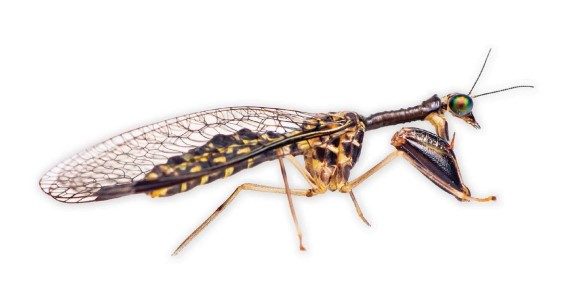
Is it a wasp? A mantis? A fly? No, it is a wasp mantidfly, an insect belonging to the Mantispidae family with mantis-like forelegs and a wasp-like body and coloration. It uses this physical mimicry to confuse predators while it hunts for its own prey.
This insect has a slender body with yellow and brown striping, a constricted waist like a wasp, and is just under an inch in length. It has a triangular head, large eyes, and raptor-like forelegs giving it the look of an amalgamation of a wasp and praying mantis. It flies on wings that are dark on the leading edges much like a paper wasp. It defends itself by spreading its wings and, like a paper wasp, it pumps its abdomen in a stinging motion. This type of mimicry is called Batesian mimicry. However, it has no stinger or venom apparatus and is therefore harmless to humans.
They can be found in North, Central, and South America. One particular species, the Climaciella brunnea is found widely across North America. They live along the edges of wooded areas, in gardens and open fields, and anywhere spiders commonly dwell, and emerge during late spring.
The mantidfly is a predator, feeding on smaller insects, including its brother or cousin (other mantidflies). Like the mantis it resembles, it is a sit-and-wait predator. Resting on flowers and shrubbery, it waits until an unsuspecting lunch passes by. It strikes with lightning speed and with its mantis-like forelegs captures and holds its meal while eating. It typically eats mosquitoes, bees, small flies, and other soft-bodied insects. It also eats nectar and tree sap.
The mantidfly has a few natural predators. For instance, birds, lizards, spider webs and large predatory wasps. Man, who seems to be a natural predator to every living thing, often kills the mantidfly by mistake, thinking it is a wasp. Environmental dangers such as the destruction of habitat and pesticides affect the mantidfly population.
The mantidfly has an important job in the insect world: population control, especially spiders. The female will lay hundreds of individual eggs on short silky stalks on the underside of leaves. Once a larva hatches, it waits until it is able to attach onto a passing female spider subsisting on its blood until the spider lays its egg sac. As it lays its egg, the mantidfly larva crawls into the egg sac and consumes the spider eggs as they are laid. The larva then remains in the egg sac until it reaches the pupal stage of its life. It spins a cocoon-like casing, and there undergoes a complete metamorphosis.
In addition to population control, the mantidfly is also a casual pollinator when its eats nectar.
The typical lifespan of the mantidfly is pretty short, from a few weeks to a few months depending on the environmental conditions.
What an amazing creation!
Sources: entomoly.umn.ed/wasp-mantidfly; waspworld.com/mantidfly-wasp
Did You Know?
Despite its appearance, the wasp mantidfly is neither wasp nor mantis. Rather, it belongs to the same family as lacewings and owlflies.
Because it looks so much like a paper wasp, it is often found flying among true paper wasps using its disguise for protection.
The mantidfly family contains species that also mimic ants and beetles.