Nature – Sand Tigers

The beetles represent the largest Order of insects, with over 250,000 described species. Within this Order is a family known as the tiger beetles, containing about 2,000 species worldwide. Tiger beetles are closely related to the ground beetles but differ from them by having the head wider than the thorax. They also have large bulging eyes, long slender legs and antennae, and large sickle-like mandibles. Many tiger beetles are quite elegant in their appearance, having intricate patterns on their elytra (modified wing covers). Others are iridescent bronze, blue, purple, or green and rival butterflies for their beauty. Their iridescent colors are the result of structural pigments and a secretion that gives an effect similar to a film of oil on water. Tiger beetles are found worldwide except in Antarctica, Hawaii, the Maldives and Tasmania. They prefer sandy or well drained soils in open areas where they run around on bare ground in search of prey. Some species are nocturnal but most are diurnal, preferring sunny, hot, environments.

Like their namesake, tiger beetles are voracious predators, preying on other insects and invertebrates, which they run down and capture with their enormous mandibles. They are fluid feeders and use what is called pre-oral digestion where they secrete digestive juices onto their prey while it is held and crushed by the mandibles, which have a special molar-like tooth to aid in this mastication. As the digestive juices break down the crushed tissues of its prey, it sucks in the juices. Tiger beetle larvae are also predators and live in holes in the ground where they ambush passing prey by popping out of the hole like a Jack-in-the-box, grabbing the prey and dragging it down deep into the hole where it is eaten.

Tiger beetles, at only .5 to 1.5 inches in length, are the fastest land insects on earth. One Australian species of tiger beetle was clocked at 5.6 miles per hour. Many of the species can run about 5 miles per hour. It is estimated that if a tiger beetle were the size of a human, it would be able to run 200–300 miles per hour. For their size, they are technically the fastest running land animals. Tiger beetles have large compound eyes, which give them a wide area of view for locating the movement of their prey. As the tiger beetles pursue their prey, they often stop to get their bearings and then proceed with the chase. This stop-and-go pursuit is necessary, as the tiger beetle’s vision shuts down after it accelerates toward prey. Moving too fast causes the beetles to not gather enough photons (illumination into their eyes) to form an image of their prey. So, the high speeds cause the tiger beetles to go blind, temporarily.

Unlike the tiger beetles that lose sight of their goal, we Christians are to fix our eyes on Christ and proceed forward without hesitation. “Will not our church members keep their eyes fixed on a crucified and risen Saviour, in whom their hopes of eternal life are centered? This is our message, our argument, our doctrine, our warning to the impenitent, our encouragement for the sorrowing, the hope for every believer. If we can awaken an interest in men’s minds that will cause them to fix their eyes on Christ, we may step aside, and ask them only to continue to fix their eyes upon the Lamb of God. … He whose eyes are fixed on Jesus will leave all. He will die to selfishness. He will believe in all the Word of God, which is so gloriously and wonderfully exalted in Christ.” Maranatha, 99.

David Arbour writes from his home in De Queen, Arkansas. He may be contacted by e-mail at: landmarks@stepstolife.org.
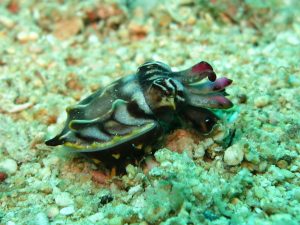
Nature – The Amazing Cuttlefish

cuttlefishCuttlefish are complex marine mollusks belonging to a class of animals which also includes the squids, octopuses, and nautiluses. Believed to be among the most intelligent of all the invertebrates, cuttlefish have a large brain-to-body size ratio. Cuttlefish look similar to squids but are more compact. They have a large head with a single fin running around the body behind the head. Encircling the mouth are eight short arms with suckers. Two longer prehensile tentacles, which can be withdrawn into pouches under the eyes, are used to capture their prey, which consist mainly of fish, crustaceans and other mollusks. Cuttlefish have a sharp parrot-like beak, which they use like a pair of scissors to cut open flesh. They also produce an ink for defense like octopuses. This ink was the original India Ink used in fountain pens and was used by artists as a pigment known as sepia.

Buoyancy in the water is controlled by an internal structure called a cuttlebone. This is porous and contains a gas and a liquid of which the ratio is regulated, similar to a submarine, enabling the cuttlefish to move up and down in the water column. Having eyes similar in construction to human eyes, cuttlefish eyes are among the most developed in the animal kingdom. The cuttlefish pupil is a smoothly curving W shape with two spots of concentrated sensor cells on the retina, one to look more forward, and one to look more backwards. Although they are color blind, they have an enhanced perception of contrast.

Cuttlefish are sometimes referred to as the chameleons of the sea, because they are masters of camouflage. They have amazing abilities to change color, light polarity and even the texture of their skin to camouflage themselves with their backgrounds for protection from predators and for ambushing their prey. These changes are also used to communicate to other cuttlefish. The transformation from one color or pattern to another can take less than a second and is controlled by the nervous system. The skin of the cuttlefish is covered with special cells that reflect light in many different colors. When excited, cuttlefish can change color, pattern and skin texture spectacularly, often flashing rapidly, through a whole gamut of colors, in just a few seconds. Males often engage in spectacular displays to attract a female, in which bands of color pass rapidly along the body like neon lights.

Like the cuttlefish, which changes its appearance for protection, so we need a change in our lives if we are to be saved. “Many a one who looks at himself in the divine mirror, and is convinced that his life is not what it ought to be, fails to make the needed change. He goes his way, and forgets his defects. He may profess to be a follower of Christ, but what does this avail if his character has undergone no change, if the Holy Spirit has not wrought upon his heart? The work done has been superficial. Self is retained in his life. He is not a partaker of the divine nature. He may talk of God and pray to God, but his life reveals that he is working against God.

“Let us not forget that in his conversion and sanctification, man must cooperate with God. ‘Work out your own salvation with fear and trembling,’ the Word declares; ‘for it is God which worketh in you both to will and to do of his good pleasure.’ Man can not transform himself by the exercise of his will. He possesses no power by which this change may be effected. The renewing energy must come from God. The change can be made only by the Holy Spirit. He who would be saved, high or low, rich or poor, must submit to the working of this power.” The Review and Herald, July 7, 1904.

David Arbour writes from his home in De Queen, Arkansas. He may be contacted by e-mail at: landmarks@stepstolife.org.

Nature – The Mighty Oak

An oak is a tree or shrub in the genus Quercus that is found mainly in the temperate regions of the Northern Hemisphere. There are about 600 species worldwide consisting of both deciduous and evergreen species. A few are found in the tropical regions of Asia and the Americas. The oaks are subdivided into five groups: the red oaks of the Americas; the white oaks of Europe, Asia, and North America; the Hungarian oak and its relatives of Europe and Asia; the Turkey oak and its relatives of Europe and Asia; and the Canyon Live oak and its relatives of southwestern North America. Most oak trees take hundreds of years to reach maturity. One tree in Windsor is over 800 years old and was planted during the reign of King John. There are others known to be over 1,000 years old. Oak trees can get quite large also, with circumferences over 60 feet, and heights pushing 100 feet, with crown spreads of over a quarter acre in size.

Oaks produce flowering structures called catkins in the spring and a nut called an acorn in the fall. Acorns take 6 to 24 months to mature, depending on the species. Acorns are rich in nutrients containing large amounts of protein, carbohydrates, and fats as well as the minerals calcium, phosphorus, and potassium, and the vitamin niacin. They also contain tannins, which are bitter to the taste and poisonous to some domestic animals. Many wild animals such as squirrels, deer, bears, and pigs consume large amounts of acorns and birds such as jays, woodpeckers, and turkeys eat their share also. Native American Indians used to gather the acorns in the fall and soak them in water to leach the tannins out, then dried and ground them to make flour.

Oak wood is famous for its great strength and hardness and is especially valued for shipbuilding, flooring, furniture, railroad ties, barrels, tool handles, and veneer. Like the acorn, the wood of the oak is high in tannins, which helps protect it against insect and fungal attacks. The oak tree is considered to be one of the most significant and magnificent trees in the whole world. Transcending times and cultures, the oak has symbolized strength and endurance, and for this reason, it has been chosen as the national tree of the United States, England, and several other countries. Overall the oak tree is a very strong and sturdy wood, and represents many things, including that of the concept of longevity and of wisdom, and is a tree that was truly designed to stand the test of time.

There are spiritual lessons to be learned from the strength and size of the mighty oak. “You should learn to rely upon your own energies and upon your heavenly Father. Youth who have been thrown upon their own resources will generally put forth the effort necessary to develop and invigorate their moral and intellectual energies. There are too many youth like the swaying willows that grow beside the meadow brook. You want to make your life the sturdy oak, springing from hardy soil amid the clefts of the rock. These have battled with the storm and tempest and yet grown into giant proportions. The great men who have done service to our country were not reared in the lap of luxury. Our greatest men are self-made.” Manuscript Releases, vol. 19, 192. “When Solomon should have been in character as a sturdy oak, he fell from his steadfastness under the power of temptation. When his strength should have been the firmest, he was found the weakest of men.

“From such examples as this we should learn that watchfulness and prayer are the only safety for either young or old.” The Retirement Years, 178.

David Arbour writes from his home in De Queen, Arkansas. He may be contacted by e-mail at: landmarks@stepstolife.org.

Nature – Crayfish

Crayfish are freshwater crustaceans resembling small lobsters. They go by a variety of different regional names such as crawfish, crawdads, mudbugs, and yabbies. Crayfish are found around the world with two families occupying The Northern Hemisphere and one family The Southern Hemisphere. There are 540 species of crayfish worldwide, with 400 of these being found in North America alone. The southeastern United States has the richest diversity of crayfish with over 330 species. Crayfish are mostly found in brooks and streams but also occur in lakes, marshes, swamps, and ponds. They come in a variety of colors, shapes, and sizes. Some species are very colorful, sporting red, blue, or yellow coloration or a combination of these, but most are a shade of brown. Others, such as the cave crayfishes, are colorless (white) and blind. Most crayfish are 2 to 6 inches in length, but a few get quite large, such as the Tasmanian giant freshwater crayfish which can reach a length of 31 inches and weigh up to 11 pounds, making it the largest freshwater invertebrate in the world. Unlike most species of crayfish which only live 2 to 3 years, the Tasmanian giant can live up to 40 years.

Some crayfish species live in holes in the ground in stream banks and moist soils, burrowing down as deep as five feet until they reach water and coming out at night to search for food on the surface. Their burrows are often marked with chimneys made of mud balls they bring to the surface while digging. There are three categories of burrowing crayfish: primary burrowers, which spend most of their lives in and around their burrows; secondary burrowers, which spend much of their lives in burrows but will frequent surface waters during wet periods, and tertiary burrowers, which generally live in surface waters but will retreat into simple burrows for reproduction and to avoid desiccation and freezing.

Crayfish are mainly nocturnal, hiding under rocks and debris during the day and coming out at night to feed. They are an important link in the aquatic food chain, being fed upon by a multitude of other animals including fish, birds, reptiles, amphibians, and mammals. Being omnivores, they feed on a variety of plants and animals and play an important role as scavengers, promoting decomposition and recycling. Crayfish sport a pair of chelipeds (pincers) for capturing food and for defense, and should they lose one to a predator, they are able to grow it back. They also are able to escape their enemies by back flipping their fan-shaped tail which propels them backward, flinging a cloud of mud at would-be predators.

In His infinite plan, God appointed part of the animal kingdom to act as scavengers like the crayfish. His plan, however, was not for us to be scavengers, physically or spiritually. “Those who live upon the husks of others’ failings and deficiencies, and who gather to themselves the unwholesome miasma of their neighbors’ neglects and shortcomings, making themselves church scavengers, are no advantage to the society of which they form a part, but are an actual burden to the community upon which they inflict themselves.

“The church is in need, not of burdens, but of earnest workers; not of faultfinders, but of builders in Zion. Missionaries are really needed at the great heart of the work—men who will keep the fort, who will be true as steel to preserve the honor of those whom God has placed at the head of His work, and who will do their utmost to sustain the cause in all its departments, even at the sacrifice of their own interests and lives, if need be.” Testimonies, vol. 4, 194.

David Arbour writes from his home in De Queen, Arkansas. He may be contacted by e-mail at: landmarks@stepstolife.org.

Nature – Army Ants

Army ants, also known as legionary ants and driver ants, are a group of over 200 species native to Central and South America and Africa. They are known for their aggressive predatory foraging groups known as “raids” which involve huge numbers of ants sweeping through an area attacking prey en masse. An army ant colony can contain up to 700,000 ants consisting of a queen, drones (males), workers, and soldiers. The workers do the hunting for food and nursery duties, and the soldiers protect the workers, queen, and nest. The soldiers are much larger than the workers and sport giant mandibles. Army ants travel about as a whole colony looking for prey and can form a carpet up to 20 meters (65.6 feet) wide. The ants can consume up to 100,000 prey animals each day.

The army ants do not construct permanent nests but build a temporary living nest with their bodies, held together with their mandibles and hooked feet, called a bivouac. The bivouac is built in hollow trees or in burrows dug by the ants. It is a well-organized structure, in the shape of a ball consisting of many passageways and chambers where food, the eggs and larvae, and the queen are kept. The older workers are located on the exterior of the nest while the younger workers are in the interior. At the slightest disturbance, soldier ants gather on the roof of the nest ready to defend it with their giant mandibles, and some species have stingers.

Army ants have two phases of activity: a nomadic (wandering) phase and a stationary phase. During the nomadic phase, most species move during the day (a few species are nocturnal) capturing insects, spiders, and small vertebrates. At dusk they form their nest, which changes location almost daily. During their foraging they are accompanied by birds known as antbirds and antwrens and numerous other birds, which feed on the invertebrates the ants flush out. During the stationary phase, which begins when their larvae pupate, they stay in one place for two or three weeks while the queen is fed extra in preparation for egg laying. After the pupae emerge and the queen lays her eggs, the colony resumes its nomadic phase.

“Go to the ant, thou sluggard; consider her ways, and be wise.” Proverbs 6:6. “The ants teach lessons of patient industry, of perseverance in surmounting obstacles, of providence for the future.” Child Guidance, 59.

“The wisest of men may learn useful lessons from the ways and habits of the little creatures of the earth. … The ants, which we consider as only pests to be crushed under our feet, are in many respects superior to man; for he does not as wisely improve the gifts of God. The wise man calls our attention to the small things of the earth: ‘Go to the ant, thou sluggard; consider her ways, and be wise: which having no guide, overseer, or ruler, provideth her meat in the summer, and gathereth her food in the harvest’ [Proverbs 6:6–8]. ‘The ants are a people not strong, yet they prepare their meat in the summer’ [Proverbs 30:25]. We may learn from these little teachers a lesson of faithfulness. Should we improve with the same diligence the faculties which an all-wise Creator has bestowed upon us, how greatly would our capacities for usefulness be increased. God’s eye is upon the smallest of His creatures; does He not, then, regard man formed in His image and require of him corresponding returns for all the advantages He has given him?” Testimonies, vol. 4, 455, 456.

David Arbour writes from his home in De Queen, Arkansas. He may be contacted by e-mail at: landmarks@stepstolife.org.

Nature – Vernal Pools

Vernal pools, also called ephemeral pools, are temporary pools of water that support a unique ecosystem of plants and animals. They can vary in size from large puddles to small lakes and occur in a variety of habitats, such as forests, prairies, and even deserts. Vernal pools are usually filled with water by rainfall or snowmelt during the winter and spring and go dry during the hot dry weather of summer. In some drought years they may not fill at all, and during really wet years they may not go dry. The underlying soils of vernal pools are a fundamental part of the habitat and usually consist of a hardpan layer or bedrock, which causes retention of the water in the pools.

Vernal pools, because of periodic drying, do not support breeding populations of fish. For this reason many species of amphibians, Odonates (dragonflies and damselflies), and crustaceans have evolved to use vernal pools as part of their life-cycles. These species are referred to as obligate vernal pool species, because they will only breed in temporary pools of water where there are no fish to eat their eggs and young.

The hydroperiod is the length of time that surface water inundates the pools and determines which species will be present. Fewer species are able to exist in pools that dry up relatively rapidly as compared to pools that keep their water longer. Toad larvae mature about the fastest of all amphibians, and they can breed successfully in the smallest of puddles, requiring just a few days to mature. They usually breed in pools that are in open sunny areas so that the extra warmth will help their larvae grow faster.

In North America, many species of mole salamanders, frogs, and toads use vernal pools for breeding. Some lay their eggs in the fall, and some lay their eggs in late winter through spring. All are capable of maturing into adults in just a few weeks before the pools go dry. Numerous aquatic insects and other invertebrates live and breed in these ponds and provide food for the growing salamander larvae. Odonate larvae are ferocious predators which feed on the larvae of other insects. The larger larvae of the dragonflies will even take small tadpoles. Fairy shrimps and various types of microscopic crustaceans live and complete their whole life-cycles in vernal pools. Their eggs are capable of surviving the dry spells and hatch when the pools flood again. Various types of algae and annual plants grow here as well and provide food for tadpoles, crustaceans, and insect larvae.

“Earth’s cisterns will often be emptied, its pools become dry; but in Christ there is a living spring from which we may continually draw. However much we draw and give to others, an abundance will remain. There is no danger of exhausting the supply; for Christ is the inexhaustible well-spring of truth. He has been the fountain of living water ever since the fall of Adam. He says, ‘If any man thirst, let him come unto me and drink.’ And ‘whosoever drinketh of the water that I shall give him shall never thirst, but the water that I shall give him shall be in him a well of water springing up into everlasting life.’ ” The Signs of the Times, April 22, 1897.

“He who drinks of the living water becomes a fountain of life. The receiver becomes a giver. The grace of Christ in the soul is like a spring in the desert, welling up to refresh all, and making those who are ready to perish eager to drink of the water of life.” God’s Amazing Grace, 119.

David Arbour writes from his home in De Queen, Arkansas. He may be contacted by e-mail at: landmarks@stepstolife.org.

Nature – The Hercules’ Club Tree

The Hercules’ Club tree (Zanthoxylum clava-herculis), also known as toothache tree, tickle-tongue, pepperwood, and Southern prickly ash, is a spiny tree or shrub in the citrus family, native to the southeastern United States. Rarely reaching over 30 feet in height, the tree gets its name from the odd spiny, warty projections on the bark of older trees, which is said to resemble the spiny club of Hercules. The leaves are pinnately compound with a citrus scent, and the spring blooming flowers are greenish yellow and produced in clusters located on the tips of the branches. The tree has a preference to grow on well-drained, light, sandy soil and is often found growing on river bluffs, woodland edges, and fencerows.

It is best known for the numbness it produces when the leaves or bark are chewed, similar to the effects of novocaine. Indians and early settlers both used it for toothaches, hence its other name, toothache tree, as well as for other medicinal uses such as sore throats, itches, ulcers, chest ailments, and venereal disease. More modern medicinal uses for the tree include poor circulation, varicose veins, chronic rheumatism, typhoid, blood impurities, skin diseases, and resistant staphylococcus. It also stimulates the lymphatic system and mucous membranes.

The tree is very valuable to wildlife. The blossoms are very attractive to bees and other pollinators, which in turn attract insect eating birds. The leaves are browsed by deer and used by a number of insect species including as a host for the larvae of the giant swallowtail butterfly. The fruits are eaten by a multitude of birds that help to disperse the seeds, which are also scarified by the birds as they pass through their digestive tract, which in turn helps them to germinate.

Just as the Hercules’ Club causes the mouth to go numb when partaken of, so our senses have been numbed by partaking of worldly amusements and sin: “A terrible picture of the condition of the world has been presented before me. Immorality abounds everywhere. Licentiousness is the special sin of this age. Never did vice lift its deformed head with such boldness as now. The people seem to be benumbed, and the lovers of virtue and true goodness are nearly discouraged by its boldness, strength, and prevalence. The iniquity which abounds is not merely confined to the unbeliever and the scoffer. Would that this were the case, but it is not. Many men and women who profess the religion of Christ are guilty. Even some who profess to be looking for His appearing are no more prepared for that event than Satan himself. They are not cleansing themselves from all pollution. They have so long served their lust that it is natural for their thoughts to be impure and their imaginations corrupt. It is as impossible to cause their minds to dwell upon pure and holy things as it would be to turn the course of Niagara and send its waters pouring up the falls. … Every Christian will have to learn to restrain his passions and be controlled by principle. Unless he does this, he is unworthy of the Christian name.” The Adventist Home, 328. “I tell you the truth. We are far behind our holy religion in our conception of duty. Oh, if those who have been blessed with such grand and solemn truth would arise and shake off the spell that has benumbed their senses and caused them to withhold from God their true service, what would not their well-organized efforts accomplish for the salvation of souls!” Testimonies to Ministers and Gospel Workers, 395.

David Arbour writes from his home in De Queen, Arkansas. He may be contacted by e-mail at: landmarks@stepstolife.org.

Nature – The Northern Flicker

Northern Flickers are large, brown woodpeckers with handsome black-scalloped plumage. Although it can climb up the trunks of trees and hammer on wood like other woodpeckers, the Northern Flicker prefers to spend much time on the ground finding its food. A portion of its diet consists of ants and beetles, and it can often be found in open, sandy areas that are heavily populated by ant colonies.

Approaching the ant mound, the flicker vigorously disturbs the doorway of the ant colony. The “doorway” tunnels underground and branches into many chambers. The ants, protective of their larvae, respond to the threat of intrusion viciously attacking insects and worms, inflicting fatal bites killing their formidable enemies. Instinctively aware of the ants’ response, the flicker disrupts the colony, drawing the ants out of their confines. Its long, blade-like tongue, coated with a special, sticky fluid and impervious to the bite of the ant, is inserted into the ant hole and, being mistaken for an intruding worm, is attacked. The sticky coating entangles the ants and the tongue is quickly removed, and the flicker devours the succulent insects and then reinserts the tongue into the tunnel. With no way for ants to escape, the flicker is able to annihilate an entire ant colony or inflict such damage to the population that tremendous effort is required for the ants to recover.

This woodpecker is able to extend its probing, sticky tongue up to three inches beyond its beak. This allows it to collect and consume huge quantities of ants in a short period of time. Besides ants, the Northern Flicker eats a variety of insects such as crickets, beetles, grasshoppers and caterpillars that are found on the ground, under debris. It also eats a variety of fruits, vegetables and berries.

The female determines the final location of their nest. If no available hollow is found, the paired flickers choose a decayed, deciduous tree, chipping and cleaning a suitable site. Carefully they remove the chips and deposit them a considerable distance from the nest to avoid it being exposed. Both the male and female share the responsibility of construction, incubation and also the feeding of the hatchlings. As they mature, survival skills are taught by hiding food for them to retrieve.

Every living thing participates in God’s divine plan, depending on Him for survival. From the least creature to God’s crowning act—Man, who was created in the image of God—all are to do His bidding in his own unique way. Instinctively birds obey, filling the air with music, fertilizing the ground, sometimes pollinating plants and at other times spreading seeds, clothing the earth in green. God said of His people, “This people I have formed for Myself; They shall declare My praise.” Isaiah 43:21.

“God has given you brain power to use. The wants of the believers and the necessities of unbelievers are to be carefully studied, and your labors are to meet their necessities. … You are a servant of the living God.” Evangelism, 650.

Nature – The Whistling Swan

After the cold months of winter pass and the northern lakes begin to thaw as the snow melts and the ice breaks apart, flocks of birds gather in preparation for their flight to their northern breeding grounds. Tundra Swans have high-pitched honking calls and sound similar to a black goose (Branta). They are particularly vocal when foraging in flocks on their wintering grounds; any arriving or leaving of other birds will elicit a bout of loud excited calling from its fellows while busily preening their feathers. They eat heavily to store layers of fat in preparation for their long migration flight to the northern Polar Regions.

This flight would be more hurried than its fall migration, for the whistling swan, the American race of the Tundra Swan,  will want to begin building its nest as early as possible. Its nesting season is short, and if the swans are to have a successful brood, they must lay, hatch and rear their young before the water freezes and winter snow once again begins to fall.

Swans do not usually associate with other birds but fly only with their own species. Their migratory flocks may be as large as five hundred in number. At the proper time the flock slowly lifts into the air with strong, steady beats of their outstretched wings. The large body of the whistling swan lifts steadily into the air as it gradually picks up speed.

This swan is aided in flight by two advantages. First, it can fly so high that it literally becomes invisible from the ground, attaining altitudes of six thousand feet. With this advantage the swan can fly above mountains and turbulent storms. A second and greater advantage is the swan’s ability to fly as a flock in V-formation. Its speed would be drastically reduced were it not for the flock’s ability to fly in this manner. The whistling swan is capable of attaining speeds of up to one hundred miles per hour.

It has been calculated that twenty-five birds flying in V-formation are able to travel seventy percent farther than one swan flying by itself. This tremendous increase in distance is possible because the lead swan “breaks the trail” for the others that follow. Consequently, air resistance is lessened as each swan benefits from the up wash of the widening wake of the one preceding it. Less total lift power is required.

The lead swan has the most difficult task. When it becomes tired, it drops back and a new leader takes over, giving it an opportunity to rest. For some swans the great northerly return flight may be as long as three thousand miles. Because of the initiative of one swan in taking the lead, the swans are able to relieve the pressure from others in the flock and greatly increase the speed at which they travel. Institute in Basic Youth Conflicts, Inc., Rand McNally and Company, 1976.

“Workers for God will meet with turmoil, discomfort, and weariness. At times, uncertain and distracted, the heart is almost in despair. When this restless nervousness comes, the worker should stop and rest. Christ invites him, ‘Come … apart, … and rest a while’ (Mark 6:31). ‘He giveth power to the faint; and to them that have no might He increaseth strength. … They that wait upon the Lord shall renew their strength; they shall mount up with wings as eagles; they shall run, and not be weary; they shall walk, and not faint’ (Isaiah 40:29–31).” Lift Him Up, 263.


Where the Waters Run

In the immense universe stretching through the vastness of space is our nearest neighbor the moon. Man has actually walked on its dry dusty face. We now know for certainty it is barren, desolate and devoid of even the simplest forms of life. What a contrast to colorful planet earth, our home—a sphere of striking beauty, green, fresh, fertile and teeming with life in great profusion. A dazzling diversity of life!

What makes the difference between the lifeless moon and the living earth? There is nothing else quite like water in the entire universe. In a surprising variety of ways the peculiar properties of water seem to have been designed expressly to make the world hospitable to life, and the earth has a great abundance of water. It covers about 70 percent of the earth’s surface. That is an estimated 326 million cubic miles of water. If the surface of the earth were perfectly smooth, the waters of the oceans would cover the earth uniformly to a depth of between 8,000 and 9,000 feet. However, only a fraction of one percent of all the water of earth can be called fresh water or water suitable for our personal use.

Most of us tend to regard this remarkable substance as ordinary, but we must not take it for granted, for in reality it is the most extraordinary substance in the universe and one upon which we are totally dependent for life.

The symbol for water, H2O—two atoms of hydrogen, and one atom of oxygen, is rather short as chemical formulas go, but that is water!

Hydrogen itself is a gas, the lightest of all elements and very flammable. Oxygen is also a gas and readily supports combustion.

Think of it—two gases—hydrogen, which is highly combustible, and oxygen which supports combustion. When combined in precisely the right proportion they form water, man’s chief agent for putting out fires.

When you heat water to 212 F it ceases to be a liquid and becomes a gas. When you cool water to 32 F it freezes. Why water reacts precisely as it does can be understood only by examining the structure of the water molecule itself, which looks something like the head of a mouse. The parts that look like the ears of a mouse represent two hydrogen atoms, the larger part represents an oxygen atom.

The two elements are quick to join each other and once together are difficult to separate because of the strong electrical attraction between them much like a magnet.

Given enough time, water will dissolve almost any other substance, for it comes closer to any other liquid to being a universal solvent and plays an important part in erosion. As water erodes, it picks up chemicals and minerals and were it not for the ability of water to dissolve or break down the molecular structure of other substances, plants would not get the nutrients they need.

Water’s force in motion is another factor dramatically evident in its power to erode. Its relentless motion through continuing centuries has helped to shape earth’s surface in rugged artistry. Cutting and chiseling through solid rock, water has sculptured deep canyons of spectacular grandeur.

Have you ever wondered why water forms into a drop or bead, how it holds itself together? Again, the explanation is found in the molecule. Once formed, water molecules join to each other in a sort of liquid latticework. In the liquid state, the negative side of one molecule is attracted or joined to the positive side of another. These attractions or bonds are formed and broken at random. At the surface where the liquid stops, the surface molecules cling to the ones below and to the sides. This cohesion creates a sort of skin that holds the water together, providing what is called surface tension. A drop of water takes the shape of a sphere. The skin of the molecule holds the sphere together. A water strider can walk on water, for the skin provides a surface.

Water skin is also illustrated in the old saying “like water off a duck’s back.” It is surface tension, which causes water to bead and roll off the bird’s back. Actually, due to surface tension these coots (swimming or diving birds) are sealed in an envelope of air as they dive, but perhaps the greatest work of surface tension in supporting life is cohesion or capillarity. Capillarity is the force that causes water to rise in a constricted space; the greater the constriction, the greater the rise. To further illustrate this principle, split the stem of a white carnation and place the parted stems in containers of colored water and you will find the different colors rise through the stem changing the color of the flower.

As water goes up the trunks of trees, capillary action is again at work. Without the ability of water to creep upward against the pull of gravity, the chemicals and minerals needed by plants to manufacture food would remain in the ground. Cohesion or capillarity is a phenomenon of water necessary to sustain life on earth.

In its solid state, water exhibits another phenomenon essential to life. In the days when the milkman delivered his product in a glass bottle, and it was left outside with the temperature below freezing, the milk would expand popping the bottle cap. Milk is 87 percent water. It was the water in the milk that froze and expanded. Almost any other substance, whether liquid, solid or gas will shrink in volume as its temperature goes down and as it shrinks it becomes more dense.

Water also shrinks during most of the temperature drop toward the freezing point, but below 40 degrees something amazingly different happens; it expands and gets less dense. As it freezes into a solid, it becomes still less dense until it has finally gained about nine percent in volume.

Why does ice float? This is because ice occupies more space than liquid water without weighing more. Since ice floats on the surface it acts as a layer of insulation, which protects the water beneath from further freezing. If water, like other liquids, were to become more dense when frozen, ice would sink and more ice would be formed at the surface. In the wintertime the rivers and streams would freeze and stop flowing, lakes would freeze solid and even the oceans might become a solid mass of ice. In the summer the sun’s heat would only melt a thin layer on the surface forming a shallow slush and life would have little chance for survival.

But God created the earth so it would sustain life, therefore the molecule of water had to be different than the molecule of all other substances. With the warmer temperatures of spring, ice readily melts. The melting liquid flows from higher elevations to lower elevations forming bodies of water. The heat of the sun and the water lifts water vapor up. The sun, air and the force of gravity all work together, as they have for centuries, to keep the hydrologic or water cycle going. Warm wet air is lighter than cold dry air, which causes it to rise. The clouds began as rising currents of warm air laden with moisture. Borne by prevailing winds the moist air cools as it rises higher and higher up steep mountain slopes and contracts as it cools literally squeezing out most of the moisture as refreshing rain. Raindrops wash the air absorbing carbon dioxide as they fall, returning to the soil as carbonic acid vital to plants and providing pure fresh water for animal and human life.

Three thousand years before the principles involved were discovered by modern science, the Bible described the water cycle with amazing accuracy. “All the rivers run into the sea; yet the sea is not full; unto the place from whence the rivers come, thither they return again.” Ecclesiastes 1:7.

More energy is expended in the water cycle in one day than man has been able to generate throughout the course of history. This alone should make us stand in awe at the power of our God.

God’s power can also be seen in the conversion of salt water to fresh. Man has long sought for a simple inexpensive way to remove salt from seawater. Survival kits employ solar stills. They operate through a process of evaporation and condensation, a process that God has been utilizing for thousands of years. The process is referred to as desalination or desalting. These solar stills successfully make the conversion providing fresh drinking water from the undrinkable ocean.

Huge plants have been developed for converting larger amounts, but so far the cost of converting enough fresh water for even one city is comparatively expensive. However, desalination could well become our prime source of fresh water. Yet from the very beginning God has converted billions of tons of salt water to fresh every day.

We’ve considered many different things about water and its unique properties. All the evidence indicates that water possesses precise properties that make life possible. These properties were not acquired through a process of random change, but were designed into water from the very beginning by the master Designer, God Himself.

What does all this mean to you personally? Think again about how much we use water. Every day we use it in hundreds of ways. In a very personal way water means a great deal. Really it is a matter of life and death. Seventy percent of the average human body is water. You constantly lose this precious body liquid and if it is not replaced, and fairly soon, you will die. It is the water in your blood that carries it through 60,000 miles of arteries, veins and branching capillaries. Water plays a major role in the digestion of food and lubrication of joints. Mucous membranes would dry up without it and without water your eyes would cease to function. Water also regulates body heat. From the beginning of time to the present, water is supporting life on earth, your life! Water with its precise properties is God’s loving provision for our physical lives.

The formula of water is simple but it is also very special and very exact. Man did not create water and cannot change its formula, but he is absolutely dependent on it. Water has no man-made substitute. Where waters run there is life; where they do not, there is desolation and death. The Bible speaks of another kind of life, spiritual life, and reveals another kind of water—Living water. The living water is the Lord Jesus Christ. To a lonely and misunderstood sinful woman long ago Christ said, “If you knew the gift of God, and who it is who says to you, ‘Give Me a drink,’ you would have asked Him, and He would have given you living water.” John 4:10 NKJV.

However, just as God’s provision for man’s physical life is precise, so is His provision for man’s spiritual life precise. Just as man did not create physical water, so he cannot create spiritual water. Just as he cannot change the formula for the one, so he cannot change the formula for the other. Just as man will die physically without the one, so he will die spiritually without the other. But just as physical water is abundantly available to man, so the spiritual or living water is also and the formula is simple but the formula is special, exact and precise. Jesus said, “No one comes to the Father but through Me.”

Man is confronted with an awesome alternative; he can receive the spiritual water and live or he can reject it and die. Remember, just as physical water can be yours for the drinking so the spiritual water can be yours for the asking and receiving—free, without cost. Christ’s invitation given centuries ago still stands: “If any man thirst, let him come unto Me, and drink. … Out of His belly shall flow rivers of living water.” John 7:37, 38.

Receive Christ now and you can experience eternal life and your spiritual life will be fully and finally satisfied. “Come … you who are thirsty; accept the water of life, a free gift to all who desire it.” Revelation 22:17 NEB.

A Moody Institute of Science Presentation, Moody Publishers, Chicago, Illinois.